
A lot of owner-financed deals start the same way. The buyer wants the property, the seller is willing to make a deal, and the bank either says no or moves too slowly to be useful. On paper, the transaction should work. In practice, it stalls because the financing path doesn't fit the deal.
That's where a carefully drafted owner-financing agreement earns its keep. In 2024, the average seller-financed home purchase note was $271,655, buyers put down an average of 27%, and the volume of these transactions rose 8% in 2024, according to AmeriSave's seller financing review. This isn't a fringe workaround. It's an active part of the market.
Those seeking a sample owner financing contract often think they need a form. Usually, they need more than that. They need a contract that still makes sense when the buyer misses a payment, when taxes go unpaid, when insurance lapses, or when the buyer reaches the balloon date and still can't refinance. Those are the points where weak templates fail and disputes begin.
Table of Contents
- Your Introduction to Owner Financing
- What Is Owner Financing and When to Use It
- The Complete Sample Owner Financing Contract Template
- An Annotated Breakdown of Key Contract Clauses
- Structuring the Financial Terms in Your Contract
- Navigating State Laws and Federal Legal Compliance
- Negotiation Tips for Buyers and Sellers
- Signing and Closing Your Deal Securely
Your Introduction to Owner Financing
A seller has a house, land parcel, or investment property that isn't moving. A buyer has income, some cash, and every intention to pay, but a conventional mortgage approval doesn't happen. Nobody wants to lose the deal. Owner financing often becomes the bridge between “almost sold” and “closed.”
The arrangement sounds simple because the seller steps into the lender's role. The hard part isn't the concept. The hard part is documenting expectations so clearly that neither side has to guess later. That's why the contract matters more than the sales pitch.
Why the paperwork matters more than the handshake
In a bank loan, the lender already has a system for payment terms, insurance requirements, tax escrows, late charges, default notices, and foreclosure rights. In owner financing, the parties have to create that system themselves, in writing.
A usable sample owner financing contract doesn't just document the sale. It allocates risk for the life of the note.
That's where many online templates come up short. They list the purchase price, the down payment, and the installment amount, but they leave out the operational clauses that keep the deal stable after closing. If the buyer can't refinance at the end of the term, a thin contract doesn't solve the problem. It magnifies it.
What Is Owner Financing and When to Use It
Owner financing is a private real estate arrangement where the seller extends credit directly to the buyer instead of the buyer borrowing from a bank. The deal is usually documented with a promissory note plus a mortgage, deed of trust, land contract, or similar instrument, as explained by Bankrate's owner financing overview.
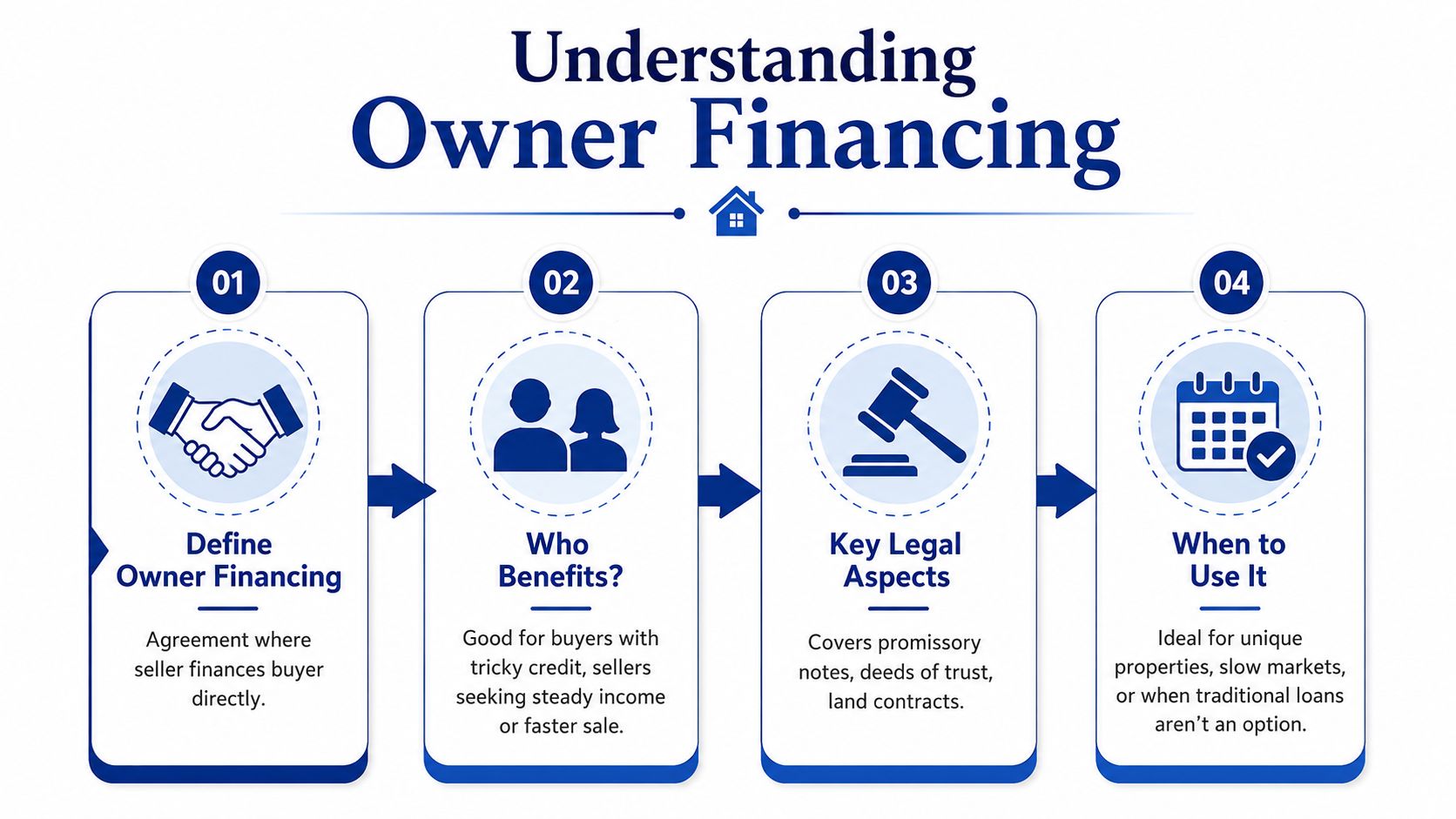
The promissory note is the promise to repay. It states the loan amount, interest rate, payment timing, maturity, and default terms. The mortgage or deed of trust secures that promise with the property. If the buyer stops paying, the seller needs that security instrument to enforce the deal.
When this structure makes sense
Owner financing tends to work best when the transaction needs flexibility that institutional lending won't provide. That may mean a unique property, a buyer with a nontraditional income history, or a seller who would rather widen the buyer pool than wait for a cash buyer.
Some practical fit scenarios include:
- Credit friction, not deal friction: The buyer and seller agree on value and timing, but bank underwriting blocks the transaction.
- Unique property issues: Rural land, mixed-use property, or homes with quirks often fit badly into standard lending boxes.
- Seller priorities: Some sellers value ongoing income, a faster sale path, or control over deal terms.
- Relationship-based transactions: Family members and people who already know each other often use this structure.
If you want a plain-language overview before looking at contract language, Dollar Land Store explains owner financing in a way many first-time buyers find easier to digest than lender-style definitions.
What works and what usually fails
What works is treating the transaction like a real loan with real servicing expectations. That means written payment dates, clear tax and insurance obligations, default notice rules, and a signed security instrument that gets handled properly at closing.
What fails is casual drafting. A two-page agreement with vague payment language might feel efficient at the kitchen table, but it doesn't hold up well when the parties disagree six months later.
A strong sample owner financing contract should answer these baseline questions:
| Issue | What the contract should say |
|---|---|
| Who are the parties | Full legal names and notice addresses |
| What property is involved | Street address and legal description |
| What is owed | Purchase price, credit terms, and payment schedule |
| What secures the debt | Mortgage, deed of trust, or contract structure |
| Who pays carrying costs | Taxes, insurance, repairs, and assessments |
| What happens on default | Notice, cure rights, remedies, and costs |
The Complete Sample Owner Financing Contract Template
A sample owner financing contract should be treated as a starting draft, not a final legal instrument. State law, deal structure, title condition, occupancy, and federal lending rules all affect the final version.
Sample contract language
Owner Financing Real Estate Purchase Agreement and Promissory Note Summary
Date: [Insert date]
Seller: [Full legal name], with notice address at [address]
Buyer: [Full legal name], with notice address at [address]
Property: The property commonly known as [street address], together with the following legal description: [insert legal description].
Purchase Price: The total purchase price for the Property is $[insert amount].
Down Payment: Buyer shall pay $[insert amount] at closing as a down payment.
Amount Financed: Seller agrees to finance the unpaid balance of the purchase price in the amount of $[insert amount], subject to the terms of the Promissory Note and security instrument executed at closing.
Interest: The financed balance shall bear interest at the rate of [insert rate] per year.
Payments: Buyer shall pay Seller monthly installments of $[insert amount], beginning on [date], and continuing on the same day of each month thereafter.
Amortization and Maturity: Payments shall be calculated on an amortization schedule of [insert period]. The unpaid principal balance, together with any accrued interest and other sums due, shall be paid in full on [maturity date].
Balloon Payment: If the loan is not fully amortized by the maturity date, Buyer shall pay the remaining balance as a balloon payment on that date, unless the parties agree in writing to an extension or modification.
Prepayment: Buyer [may/may not] prepay all or part of the indebtedness without penalty.
Late Charges: If any monthly payment is not received within [insert period], Buyer shall pay a late charge of $[insert amount] or the maximum amount allowed by applicable law.
Taxes and Insurance: Buyer shall timely pay all property taxes, assessments, and charges relating to the Property. Buyer shall maintain property insurance in amounts reasonably required by Seller and provide proof of coverage upon request.
Maintenance and Waste: Buyer shall maintain the Property in good condition and shall not commit waste or permit any material impairment of the collateral.
Title and Closing Documents: At closing, the parties shall execute and deliver all documents required to complete the transaction, including the deed, promissory note, and [mortgage/deed of trust/land contract], as applicable.
Default: Buyer shall be in default upon failure to make payments when due, failure to maintain insurance, failure to pay taxes or assessments, unauthorized transfer, material breach of this agreement, or other grounds stated in the loan documents.
Notice and Cure: Before exercising remedies, Seller shall provide written notice of default describing the breach and any cure period allowed under this agreement or applicable law.
Remedies: Upon uncured default, Seller may exercise any rights available under the note, security instrument, and applicable law, including acceleration of sums due and enforcement against the Property.
Balloon Maturity Failure: If Buyer cannot refinance or satisfy the balloon payment by the maturity date, the parties [may/may not] negotiate an extension. Any extension must be in writing and should state the revised maturity date, any principal reduction required, the payment amount during the extension, and whether additional default protections apply.
Possession: Buyer shall take possession on [date], subject to the terms of this agreement.
Closing Costs: Closing costs shall be allocated as follows: [insert terms].
Disclosures and Condition: The Property is conveyed subject to any written disclosures, inspection rights, repair agreements, and condition terms stated in this agreement.
Attorney Fees and Costs: In any dispute arising from this agreement, the prevailing party shall be entitled to recover attorney fees and costs if permitted by applicable law and the contract terms.
Entire Agreement: This agreement, together with the note, deed, and security instrument, contains the entire agreement between the parties.
Amendments: Any amendment must be in writing and signed by both parties.
Governing Law: This agreement shall be governed by the law of the state where the Property is located.
Signatures: Seller and Buyer agree to execute this agreement and all related closing documents.
How to use this template correctly
This draft is broad on purpose. It gives you the framework you need before counsel turns it into state-specific documents. Don't copy it into a closing package and assume you're done.
Use it instead as a negotiation worksheet:
- Fill in the business terms first: price, down payment, payment timing, maturity, possession, and closing costs.
- Mark the risk points: taxes, insurance proof, late payment handling, and transfer restrictions.
- Write the balloon strategy separately: extension rights, principal curtailment, or modification process.
- Send the draft for legal review: the promissory note and security instrument must align with the purchase terms.
- Prepare the signature process: if you're collecting signatures electronically, this guide on adding a digital signature block to a PDF is a practical place to start.
Don't judge a contract by how quickly you can fill it out. Judge it by whether it still works after the first dispute.
An Annotated Breakdown of Key Contract Clauses
A contract can look complete and still leave dangerous gaps. The most common problem isn't missing boilerplate. It's vague drafting in the clauses that matter once money changes hands.
The clauses that define the deal
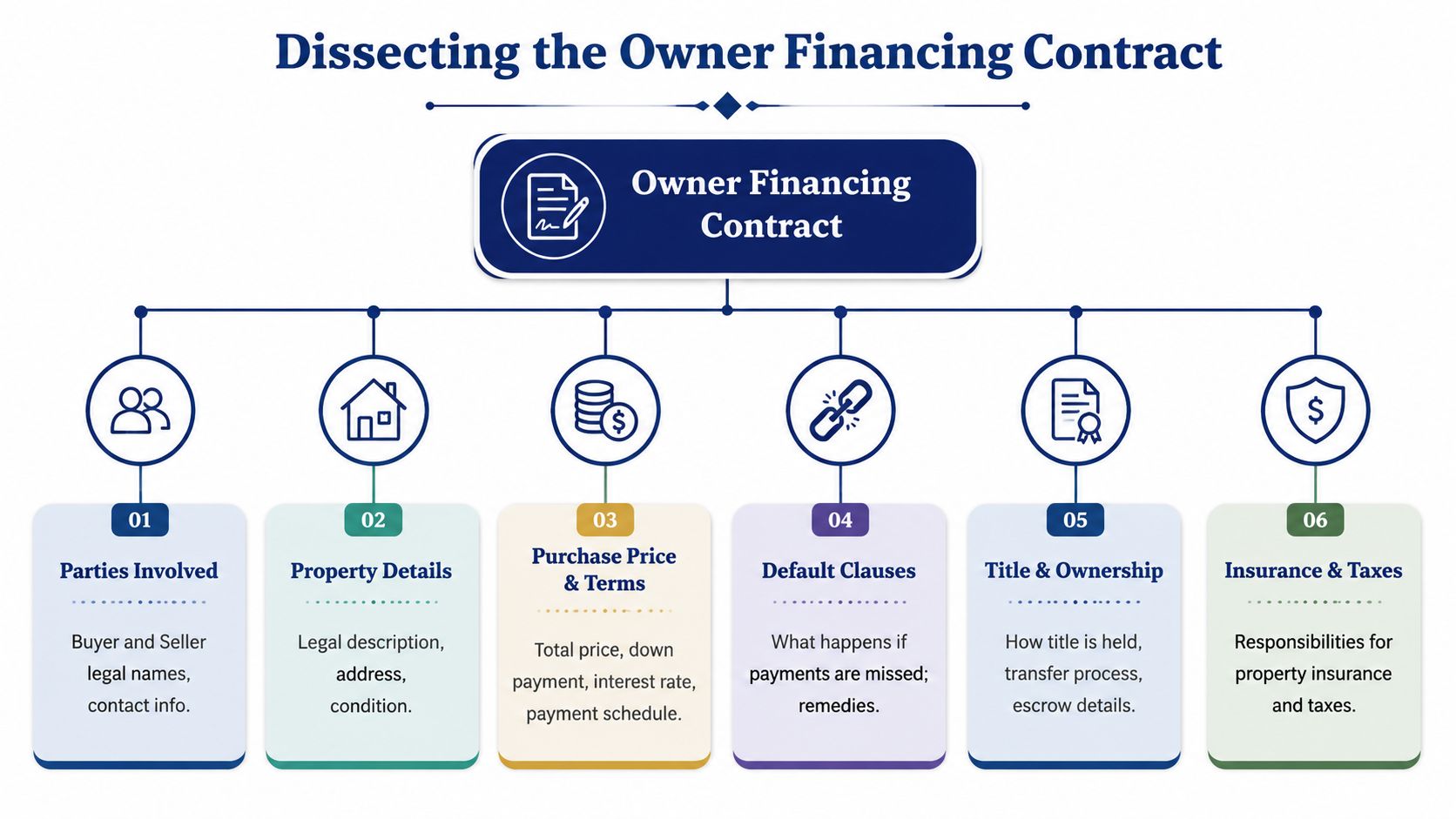
Parties and property description come first for a reason. If the legal names are wrong, notices can miss the mark. If the property description is sloppy, the security documents can become harder to enforce. Street address alone usually isn't enough for the final closing set.
Purchase price and financed amount should leave no room for arithmetic fights. State the total price, then separately state the down payment and the amount financed. If the buyer receives credits, say exactly what they are and whether they reduce cash due at closing or principal financed.
Payment terms need more than a monthly number. The note should identify the due date, where payment goes, what counts as timely receipt, and how partial payments are handled. Sellers often assume they can reject partial payments at will. Buyers often assume any money sent stops default. Your documents should resolve that question.
For anyone drafting the note and deed of trust together, it helps to review how lawyers ensure legal enforceability of notes through coordinated drafting rather than piecemeal forms.
The clauses that control trouble
When people skim owner-finance documents, they usually jump to interest rate and closing date. The clauses with the most practical weight are often elsewhere.
- Taxes and assessments: If the buyer is responsible, say when proof must be provided and what happens if payment isn't made.
- Insurance: Require ongoing coverage and specify whether the seller must be listed for notice purposes.
- Maintenance and waste: This matters when the buyer has possession long before full payoff.
- Due-on-sale or transfer limits: Sellers often want to prevent an unapproved transfer of the property or contract rights.
- Default notice and cure: A notice provision without a real cure process often creates confusion instead of advantage.
- Attorney fees and enforcement costs: These shape settlement behavior when a dispute starts.
A better contract doesn't assume default means immediate collapse. It establishes a sequence. Notice. Cure opportunity if applicable. Acceleration if appropriate. Enforcement through the agreed legal path.
If a default clause only says the seller may “take the property back,” the contract is not finished. It's inviting litigation.
The balloon provision deserves special treatment
Many weak templates prove inadequate. Legal guidance emphasizes that owner-finance contracts should define how long the buyer has to convert to traditional financing, what happens if that doesn't occur, and what the buyer's exit strategy looks like in writing, as discussed in Neal & Davis's drafting guidance.
The practical problem is simple. A balloon payment sounds manageable at closing because the maturity date feels far away. It stops feeling manageable when rates change, underwriting tightens, property condition slips, or the buyer's financial profile doesn't improve on schedule.
A resilient sample owner financing contract addresses that risk before the first payment is ever made.
Better ways to draft the balloon clause
A stronger balloon clause can include options such as:
- Written extension mechanics: not an open-ended promise to “work something out,” but a defined process.
- Required principal reduction: the buyer may need to pay down a portion of the balance as a condition of extension.
- Updated payment terms during extension: state whether the monthly payment changes.
- Document deadlines: require a refinance application or proof of lender communication before maturity.
- Default fallback: define what happens if the parties do not agree to extend.
Here's the trade-off. A seller wants certainty and a real maturity date. A buyer wants enough flexibility to avoid losing the property because one refinance deadline was missed. Those goals can coexist, but only if the contract sets objective conditions.
One practical method is to separate maturity default from ordinary payment default. Missing a monthly payment and missing a refinance deadline are not the same event. They shouldn't always trigger the same cure rules or settlement options.
Structuring the Financial Terms in Your Contract
The financial terms aren't just numbers dropped into blanks. They tell both parties how much risk each side is taking and how likely the deal is to survive.
Set the down payment first
Bankrate notes that owner-financing terms are often short, usually 5 to 10 years, often with a balloon payment, and that sellers should consider requiring a 15% down payment if possible in order to reduce risk, as outlined in Bankrate's owner financing guide.
That benchmark is useful because the down payment does several jobs at once. It tests buyer commitment. It gives the seller a cushion if enforcement becomes necessary. It also changes the psychological tone of the deal. Buyers who have meaningful cash in the property tend to treat the obligation like a mortgage, not a casual installment plan.
Match the payment structure to the exit plan
A short-term note with low monthly payments can look attractive, but the lower the principal reduction during the term, the larger the maturity problem becomes. That doesn't make balloon structures bad. It means they need a realistic payoff path.
When I review these agreements, I look for alignment between the payment structure and the buyer's likely refinance path. If the buyer's plan depends on future credit repair, business seasoning, title cleanup, or property improvements, the note should not pretend those steps are automatic.
A workable financial discussion usually covers:
- The purchase price: supported by the parties' own valuation judgment and any appraisal they choose to obtain.
- The down payment: enough to protect the seller and show buyer commitment.
- The interest rate: clearly fixed or clearly adjustable under the agreed terms.
- The amortization approach: whether the payment schedule pays down principal in a meaningful way.
- The maturity plan: refinance, sale, cash payoff, or agreed extension path.
Shorter terms can help a seller limit long-term exposure. They can also push too much risk into the final payoff if the buyer's exit plan is weak. The contract should reflect that reality instead of hiding it.
Navigating State Laws and Federal Legal Compliance
A generic sample owner financing contract can help you organize business terms. It cannot tell you whether your structure complies with the law in your state or with federal lending rules. That's where many self-prepared agreements run into trouble.
Why generic forms create legal risk
Real estate law is local in all the ways that matter. States differ on foreclosure procedure, land contract treatment, notice requirements, deed formalities, recording practice, and how defaults must be handled. A clause that works in one jurisdiction may be incomplete or counterproductive in another.
That's why parties should get local legal review before closing. If you want a broad primer on lender-side concerns before bringing in a private lender or structuring credit, LendingXpress on real estate legalities is a useful high-level read.
Federal rules can change the whole structure
Federal law also matters. Under Dodd-Frank and related rules, a seller financing three or fewer properties in a 12-month period may qualify for an exemption only if the loan is fully amortizing, has no balloon payment, uses a fixed rate or qualifying adjustable structure with caps, and is supported by a good-faith ability-to-repay determination. Separately, extending consumer credit more than five times in a calendar year can trigger ability-to-repay obligations, as summarized by Barnes Walker on seller financing restrictions under Dodd-Frank.
That matters because the contract structure some parties want most, especially a short note with a balloon, may not fit the exemption path they assumed was available.
If you're coordinating signatures remotely, approvals and audit records also matter. This overview of e-signatures for sales contracts is useful when your closing process includes electronic execution.
Compliance isn't a formatting issue. It can change whether your deal structure is legal in the first place.
Negotiation Tips for Buyers and Sellers
The best owner-financed deals don't come from one side “winning” the paper. They come from both sides transparently addressing the risks that are most likely to surface later.
What buyers should push for
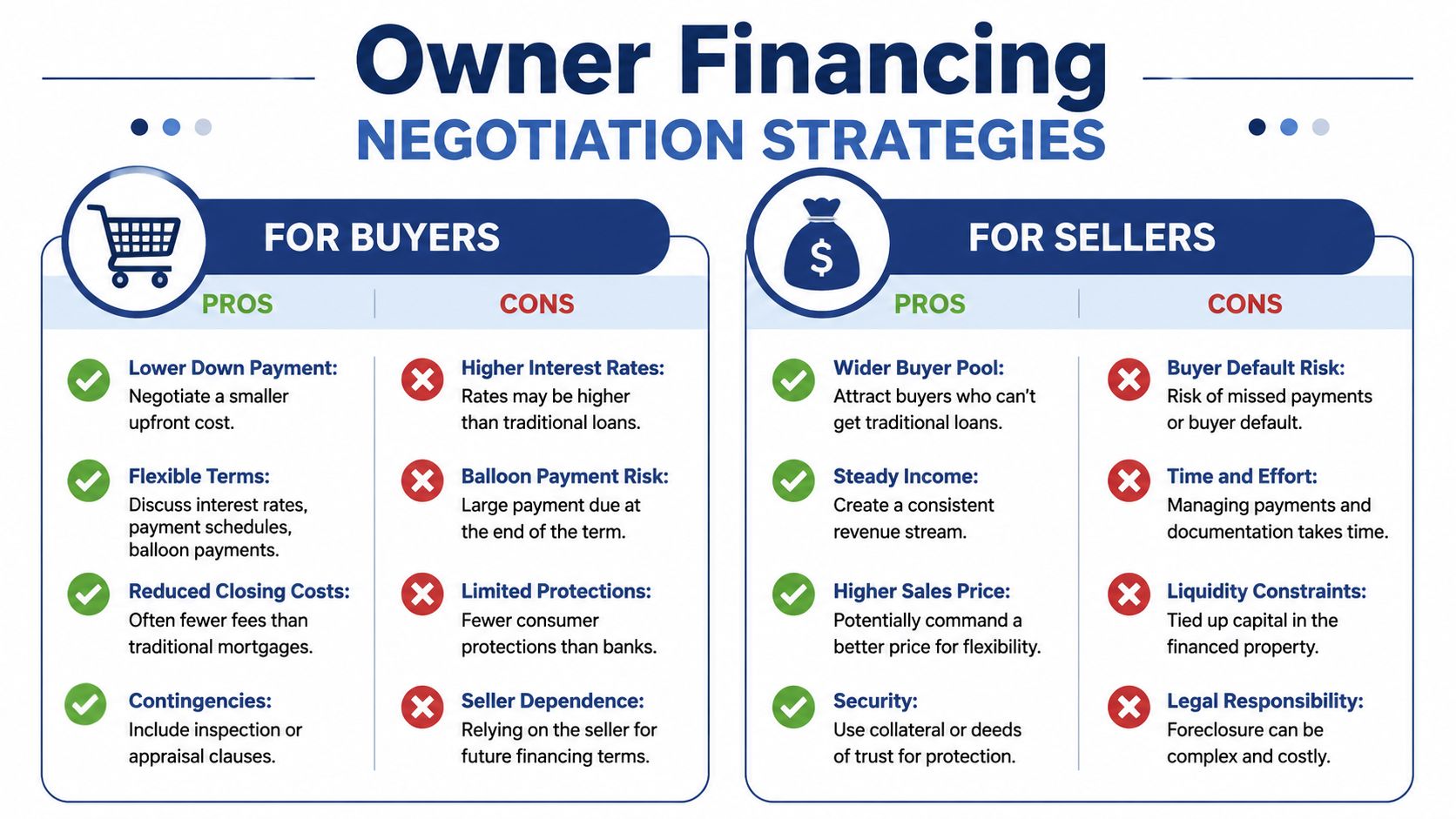
Buyers usually focus on the upfront economics. They should also negotiate for procedural protection.
- Cure rights: Ask for a clear notice period before serious remedies kick in.
- Prepayment flexibility: If refinancing early is the goal, a prepayment penalty can become an unnecessary obstacle.
- Balloon extension language: If the exit plan depends on later refinancing, try to negotiate objective extension conditions in advance.
- Inspection and condition terms: Don't let financing urgency erase standard property diligence.
A short video can help frame the back-and-forth points in plain language:
What sellers should protect
Sellers should treat the deal like asset-backed lending, because that's what it is.
- Down payment strength: Cash equity reduces the chance of quick default.
- Insurance verification: Don't rely on verbal assurances.
- Tax payment proof: Delinquent taxes can create priority problems.
- Transfer controls: Prevent informal handoffs to third parties.
- Default remedies that can be enforced: Broad language is less useful than precise procedures.
Negotiation goes better when both sides identify their essential terms early. A seller may care most about equity and enforcement. A buyer may care most about flexibility at maturity. Those aren't incompatible if the contract turns them into specific obligations instead of vague expectations.
Signing and Closing Your Deal Securely
By the time the deal is ready to sign, most of the main work should already be done. The parties should know exactly what is being sold, what is being financed, what gets signed at closing, and what happens if the note goes off track later.
Closing checklist
Before signing, confirm these items in one final pass:
- Names and property description: match the deed, note, and security instrument.
- Financial terms: verify the purchase price, credits, financed amount, and payment schedule.
- Risk clauses: check taxes, insurance, possession, default, notice, and balloon language.
- Execution package: make sure every required exhibit, disclosure, and attachment is included.
- Recording plan: confirm who records the deed and security instrument and when.
Using electronic signatures the right way
Electronic signing can make owner-financing closings easier to manage, especially when buyer, seller, title personnel, or counsel are not in the same room. The important point is legal validity and recordkeeping, not novelty.
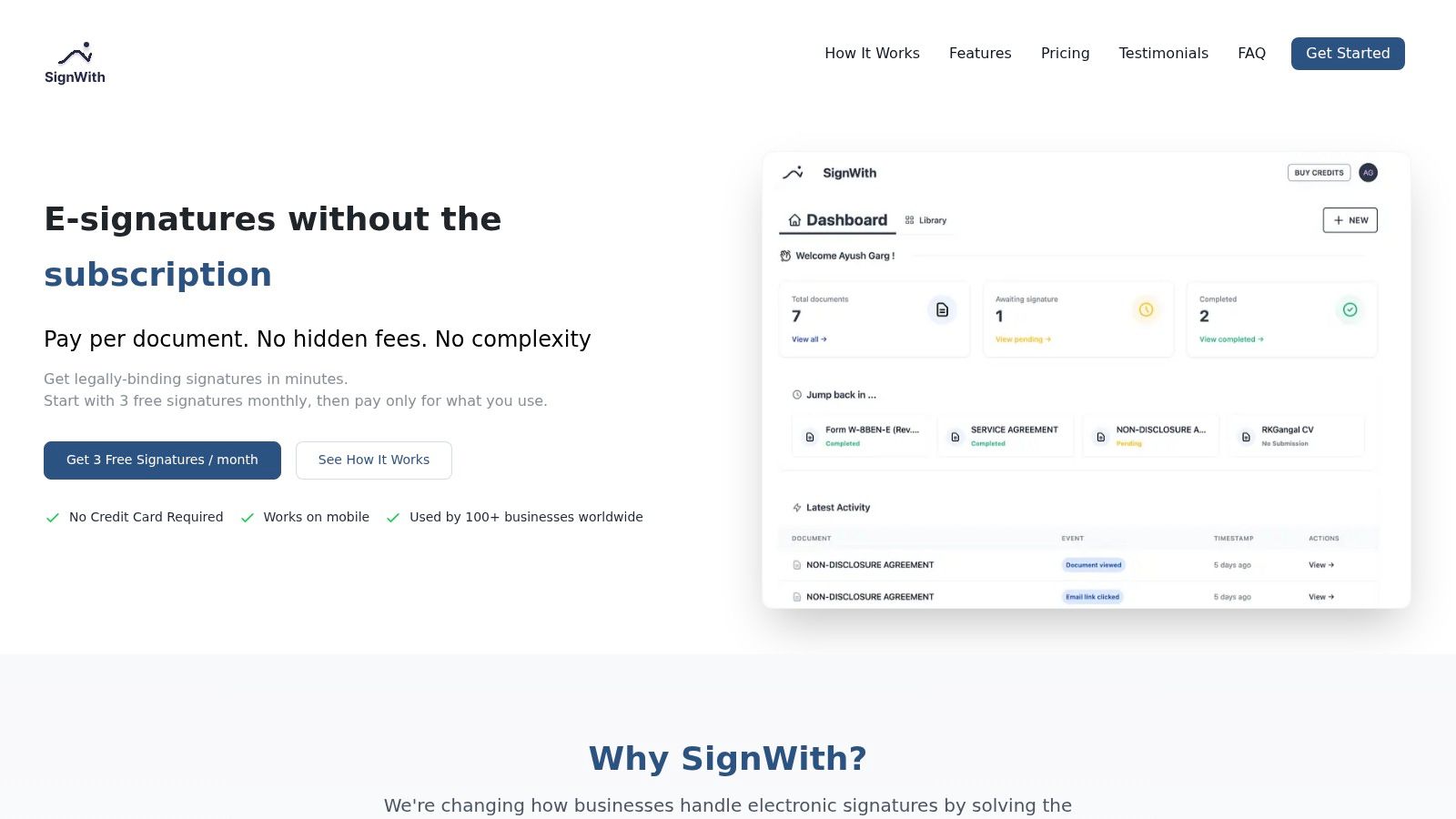
SignWith is one example of a platform that lets users send signature-ready documents and is compliant with the USA standards for electronic signatures under the ESIGN Act and UETA. If you're preparing documents for remote execution, this guide on how to sign a contract electronically is a practical reference.
Keep signed copies organized. Keep the final versions identical across all parties. And make sure the documents that need recording are signed in the form your local recording office requires.
If you need to send an owner-financing agreement without paying for another monthly software subscription, SignWith is a straightforward option for uploading documents, placing signature fields, and completing legally binding electronic signatures under the ESIGN Act and UETA.