
You land a new client. The kickoff call goes well, the scope sounds manageable, and the client says, “Just send the invoice when you're done.”
That feels good for about an hour.
Then the practical questions start creeping in. What exactly counts as “done”? How many revisions are included? When do you get paid? Who owns the final work? What happens if the project stalls halfway through because the client disappears, changes direction, or asks for “one small extra thing” five times in a row?
That's the moment most freelancers start searching what is a service contract and realize they weren't asking a legal question. They were asking a business survival question.
A service contract is the document that turns a vague working relationship into a clear operating agreement. It doesn't kill trust. It protects it. It gives both sides the same map before the work starts, while the relationship is still easy and optimistic.
Table of Contents
- Why Handshakes and Emails Are Not Enough
- Defining the Service Contract Beyond the Jargon
- Essential Clauses Every Service Contract Needs
- Clearing Up Common Contract Confusion
- How Professionals Use Service Contracts Every Day
- From Draft to Done The Smart Way
- Your Next Step Toward Professional Confidence
Why Handshakes and Emails Are Not Enough
A lot of small projects begin informally. A referral comes in. You trade a few emails. Someone says, “This all looks fine to me.” Work starts on goodwill and momentum.
That works right up until memory and expectation stop matching.

The problem isn't bad intent
Most disputes don't start because someone planned to be difficult. They start because each side filled in the blanks differently. A freelancer thinks the quoted price includes one homepage and one contact page. The client assumes it includes copywriting, image sourcing, SEO setup, and unlimited tweaks until the site “feels right.”
Neither side thinks they're changing the deal. They think they're following it.
Practical rule: If a term matters to money, timing, or ownership, don't leave it sitting in an email thread.
Email chains are especially bad at carrying the full weight of an agreement. Details get scattered across replies, attachments, call notes, and “just confirming” messages. When a disagreement shows up, both sides hunt through inboxes trying to reconstruct what they thought they agreed to.
A contract gives the work edges
A service contract solves that by putting the core terms in one place. It defines the service, the fee, the timing, the approval process, and the exit path if things go sideways.
Think of it less like a courtroom document and more like guardrails on a road:
- Scope guardrail: Keeps the project from drifting into unpaid extras.
- Payment guardrail: Tells everyone when invoices go out and when money is due.
- Timeline guardrail: Prevents endless “almost finished” projects.
- Relationship guardrail: Gives both sides a process when something changes.
Without that structure, even a good client relationship can become tense. With it, the work feels calmer. You don't have to improvise your boundaries in the middle of a stressful conversation. The contract already did that work for you.
Defining the Service Contract Beyond the Jargon
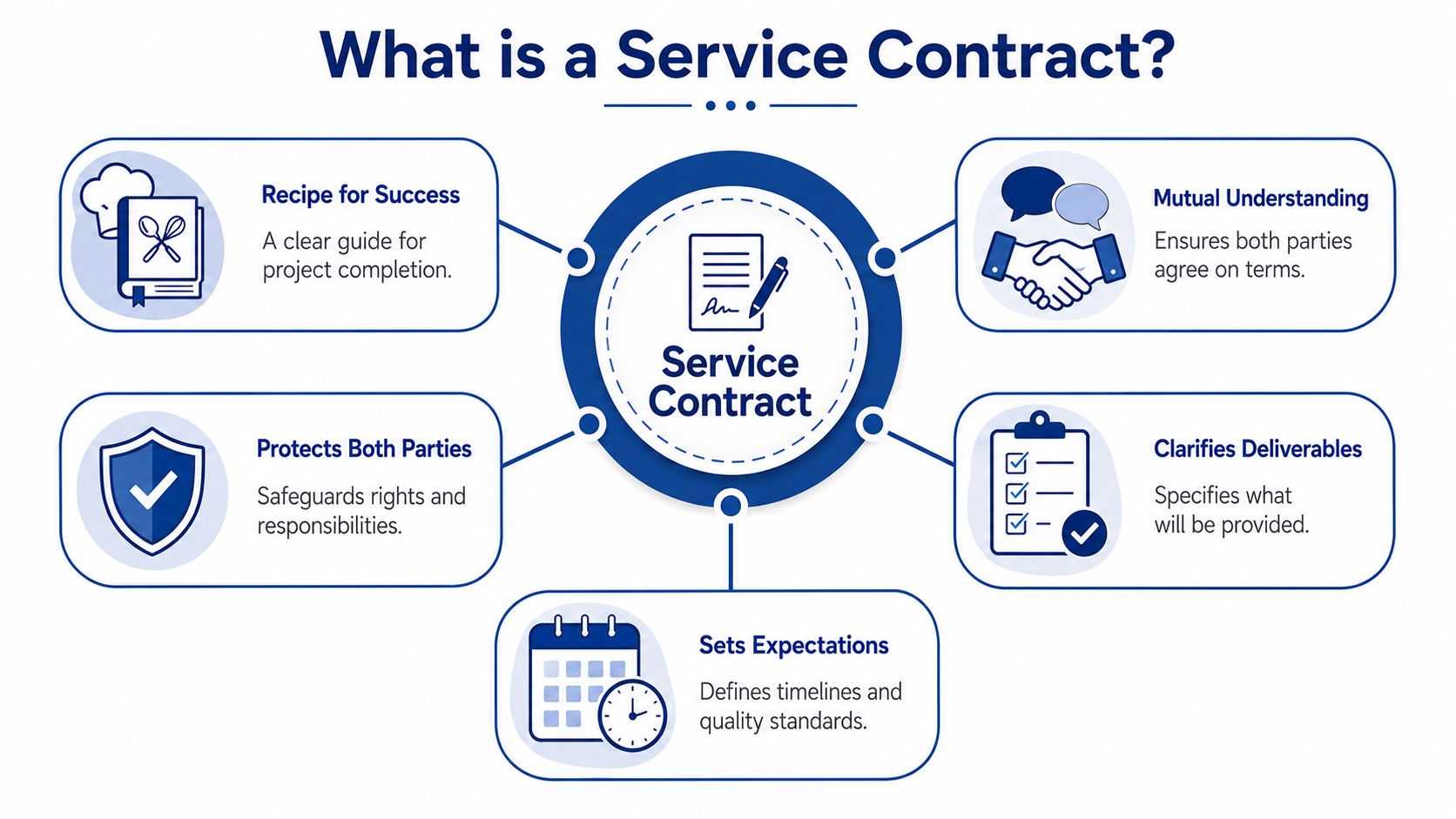
A service contract is easiest to understand if you think of it as a recipe for a successful project. It says what's being made, who does what, when key steps happen, and what “finished” looks like.
That sounds simple, but many people get confused because the phrase “service contract” is used in different legal and business contexts.
A practical definition that actually helps
In everyday business, a service contract is a written agreement where one party performs a service for another under defined terms. For freelancers, consultants, agencies, and small vendors, that usually means design work, writing, development, marketing, maintenance, or advisory services.
The useful question isn't just “what is a service contract.” It's “which kind are we talking about?”
That distinction matters because the legal rules and business risks are different.
The three categories that people mix up
B2B service contracts are the agreements most freelancers use. A designer agrees to build a brand kit. A developer agrees to maintain a website. A consultant agrees to deliver strategy sessions and reports. These contracts focus on scope, payment, ownership, confidentiality, and deadlines.
Consumer service contracts are something else. Under 15 USC § 2301(8), a service contract is a written agreement to perform, over a fixed period or specified duration, services relating to the maintenance or repair of a consumer product. That's the world of extended coverage plans for products, not your average freelance client engagement.
Government service contracts have another layer entirely. Under FAR Subpart 37.1, a service contract directly engages the time and effort of a contractor to perform an identifiable task rather than furnish an end item of supply. And when federal labor standards come into play, confusion gets expensive. A key compliance gap noted in FAR Subpart 22.10 is that over 50% of new federal contractors misidentify their contract's labor compliance requirements, often because they assume consumer-style definitions apply to government work.
That's why a freelancer moving into subcontracting or federal work can't rely on consumer-language assumptions.
If you're serving a business client, selling extended repair coverage, and bidding on government work, you may be using three different kinds of “service contract” language in the same year.
For teams working across borders or handling ongoing performance commitments, it also helps to understand how international commercial law SLAs fit beside core service agreements. They don't replace the contract. They sharpen the performance expectations inside it.
Essential Clauses Every Service Contract Needs
A strong contract doesn't need dramatic legal language. It needs the right clauses in plain English. If a clause prevents a common argument, it belongs in the document.
The clauses that prevent the most common problems
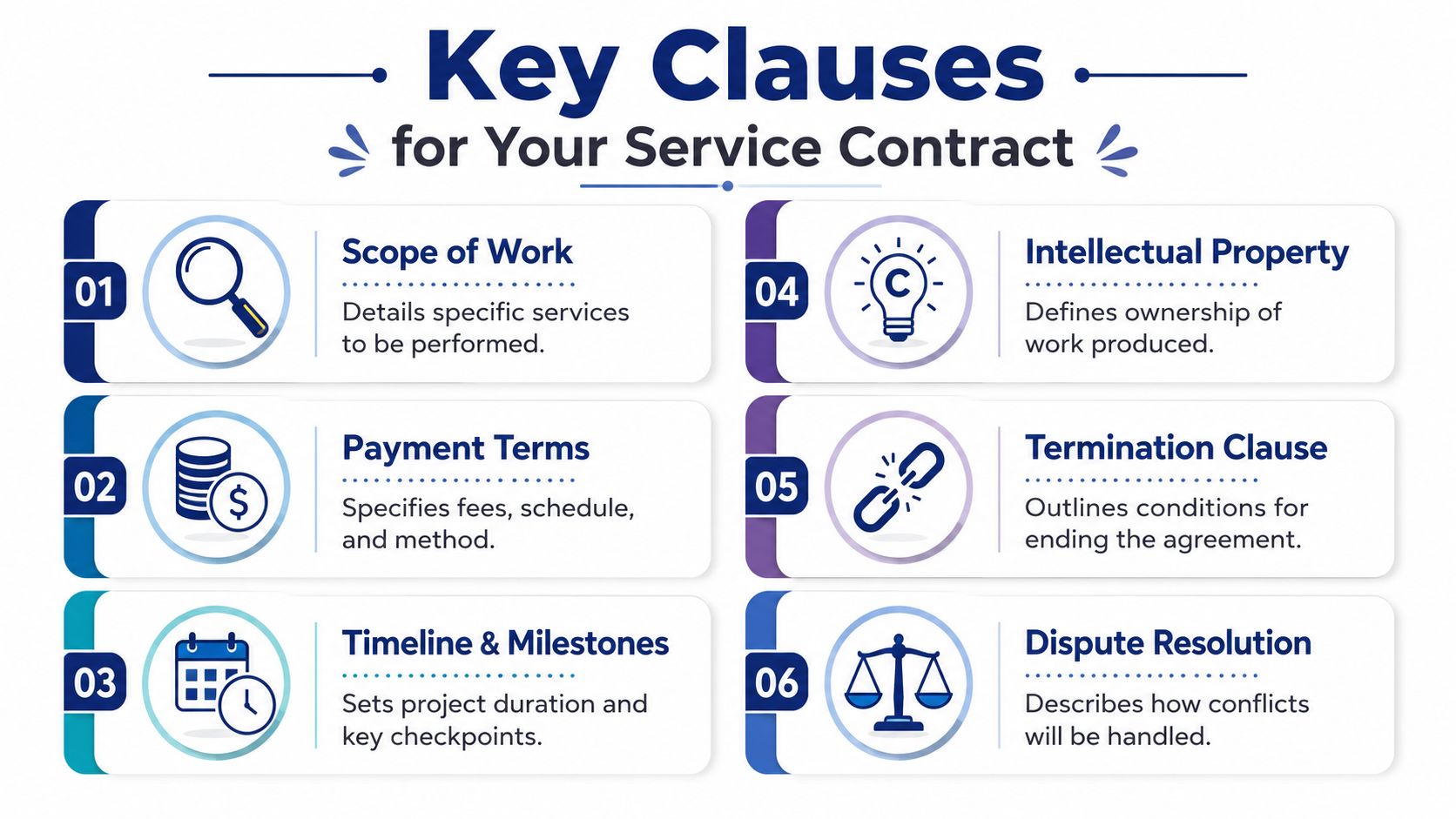
Start with scope of work. This is the backbone. It should say what you will do, what you won't do, what the client must provide, and how change requests are handled. If you skip this, the project expands through assumptions.
Then nail down payment terms. Include fee structure, invoice timing, due dates, accepted payment methods, and what happens if payment is late. The goal isn't to sound tough. The goal is to avoid the awkward “I thought I paid after launch” conversation.
A good contract also needs timeline and milestones. Spell out key dates, dependencies, review windows, and what delays the schedule. If client feedback is late, the timeline should move accordingly.
Here's a simple checklist you can use:
- Scope of work: List deliverables, revision limits, excluded tasks, and client responsibilities.
- Payment terms: State whether pricing is fixed, hourly, retainer-based, or milestone-based.
- Deliverables and deadlines: Tie each output to a date, event, or approval stage.
- Intellectual property: Clarify when ownership transfers and what rights you retain.
- Confidentiality: Protect business information, drafts, data, and client materials.
- Termination: Decide how either side can end the agreement and what payment is still owed.
- Dispute resolution: Say how conflicts will be handled before they turn into expensive standoffs.
A short explainer can also help if you want another perspective on contract structure:
Why technical detail matters
Many freelancers think “technical specifications” are only for construction, software procurement, or government bids. That's too narrow. In practice, any project benefits from precise performance language.
Technical specifications act as enforceable benchmarks for quality, regulatory compliance, and acceptance criteria. In verified procurement cases, when specifications focus on functional outcomes, contractor innovation increases by 22% while compliance failures drop by 15%.
That idea applies cleanly to freelance work. “Design a modern website” is vague. “Deliver a five-page website with mobile responsiveness, contact form integration, and client review at each milestone” is far safer.
The best contract language answers the client's next question before they ask it.
Here's what works better than broad promises:
| Clause area | Weak wording | Stronger wording |
|---|---|---|
| Scope | “Provide marketing support” | “Write four email campaigns and two landing page drafts” |
| Revisions | “Edits included” | “Two revision rounds per deliverable” |
| Timeline | “Complete soon” | “Draft due within five business days of receiving materials” |
| Approval | “Client signs off” | “Approval required by email within three business days” |
You don't need to turn a simple project into a procurement manual. You do need enough detail that a third party could read the contract and understand what each side owes.
Clearing Up Common Contract Confusion
A lot of business owners use service contract, warranty, and SLA as if they mean the same thing. They don't. They solve different problems.
One simple comparison
Use a web hosting example. You buy a server appliance, add a repair plan, and also sign up for managed hosting support.
The product might come with a warranty. The repair plan is a service contract. The uptime commitment is an SLA.
| Attribute | Service Contract | Warranty | SLA (Service Level Agreement) |
|---|---|---|---|
| Main purpose | Covers defined services over time | Covers product defects or condition at delivery | Sets performance standards for ongoing service |
| Typical use | Maintenance, repair, ongoing support | Product quality assurance | Response times, uptime, support levels |
| Focus | Future work to be performed | Defects in the product | Measurable service performance |
| Best example | Device repair plan or maintenance agreement | Manufacturer warranty on delivered equipment | Managed hosting uptime and response commitment |
Under the legal definition in 15 USC § 2301(8), a service contract covers maintenance or repair services for a consumer product over a defined period. That's different from a warranty, which covers defects in shipped products.
Where freelancers get tripped up
Freelancers usually aren't selling warranties. They're selling labor, expertise, and deliverables. But they may still use SLA-style language when they promise support response times, revision windows, maintenance windows, or issue resolution targets.
For example:
- A website build contract is the main service contract.
- A bug-fix commitment after launch may look like limited support terms.
- A maintenance plan with response targets starts to overlap with SLA language.
If your work includes ongoing support, separate the ideas clearly. Put the core business terms in the contract, then define the service level commitments in a dedicated schedule or appendix.
If you want a cleaner breakdown of signature terminology while you're reviewing contract documents, this comparison of digital signature vs. electronic signature is useful because people often confuse those terms too.
A warranty says, “This product shouldn't arrive broken.” An SLA says, “This service should perform at a defined level.” A service contract says, “Here is the work we will do, and under what terms.”
How Professionals Use Service Contracts Every Day
The easiest way to understand contracts is to watch how working professionals lean on them in ordinary situations.
Three everyday examples
A graphic designer quotes a brand package with logo concepts, color palette, and typography guidance. The client keeps asking for “just one more direction.” Because the contract limits concept rounds and revision cycles, the designer can respond without sounding defensive. The answer becomes operational, not emotional: additional rounds are available as extra work.
An IT consultant agrees to monthly support for a small firm. The payment section says invoices go out at the start of each month, and access to support pauses if invoices remain unpaid past the agreed date. That clause protects cash flow without forcing the consultant to renegotiate every month.
A content writer creates a set of articles for a software company. The intellectual property clause says ownership transfers only after full payment. That keeps the writer from losing control of finished work while an invoice drifts.
These aren't dramatic stories. That's the point. Good contracts do their best work smoothly.
When government work changes the rules
The picture changes if you move into public sector work, subcontracting, or labor-based federal projects. The Service Contract Act of 1965 mandates prevailing wage and benefit standards for employees on U.S. government contracts, covering service categories that include janitorial services, facility maintenance, security operations, and information technology support.
A freelancer may not feel the impact on a one-off design job. But the moment you start supporting a government prime contractor, staffing labor categories, or delivering ongoing operational services, contract language can trigger compliance obligations outside the usual freelance playbook.
That's also why it helps to understand understanding PEO contract breaches when your business relies on outsourced employment or operational partners. Your client contract may be solid, but a weak vendor relationship behind the scenes can still create delivery problems.
A practical takeaway for small operators is simple:
- Client-facing projects: Keep the contract clear and readable.
- Support retainers: Add response, maintenance, and escalation detail.
- Government-adjacent work: Check whether labor and compliance rules apply before you sign.
From Draft to Done The Smart Way
Most contract trouble starts before the signature. It starts in vague drafting, rushed review, or a negotiation process that feels adversarial for no reason.
Draft clearly and negotiate calmly
Start from a reliable template, then customize the business terms. Don't copy random clauses from three different contracts and stitch them together. That usually creates contradictions.
Write like you expect a busy client to read it on a phone. Short sections. Clear labels. Defined dates. Plain language. If a clause sounds impressive but nobody can explain it in a sentence, rewrite it.
Good negotiation also sounds more collaborative than defensive. Instead of saying, “My lawyer requires this,” say, “This clause keeps the project moving if timelines slip or scope changes.” Clients usually accept structure more easily when they understand the operational reason behind it.
A good final review includes:
- Match the proposal to the contract: Make sure deliverables and price still align.
- Check dependencies: Note what you need from the client to begin and continue.
- Define approval paths: Decide who signs off and how approval is documented.
- Confirm termination logic: If the work stops, the contract should still tell you what happens next.
Sign in a way that holds up
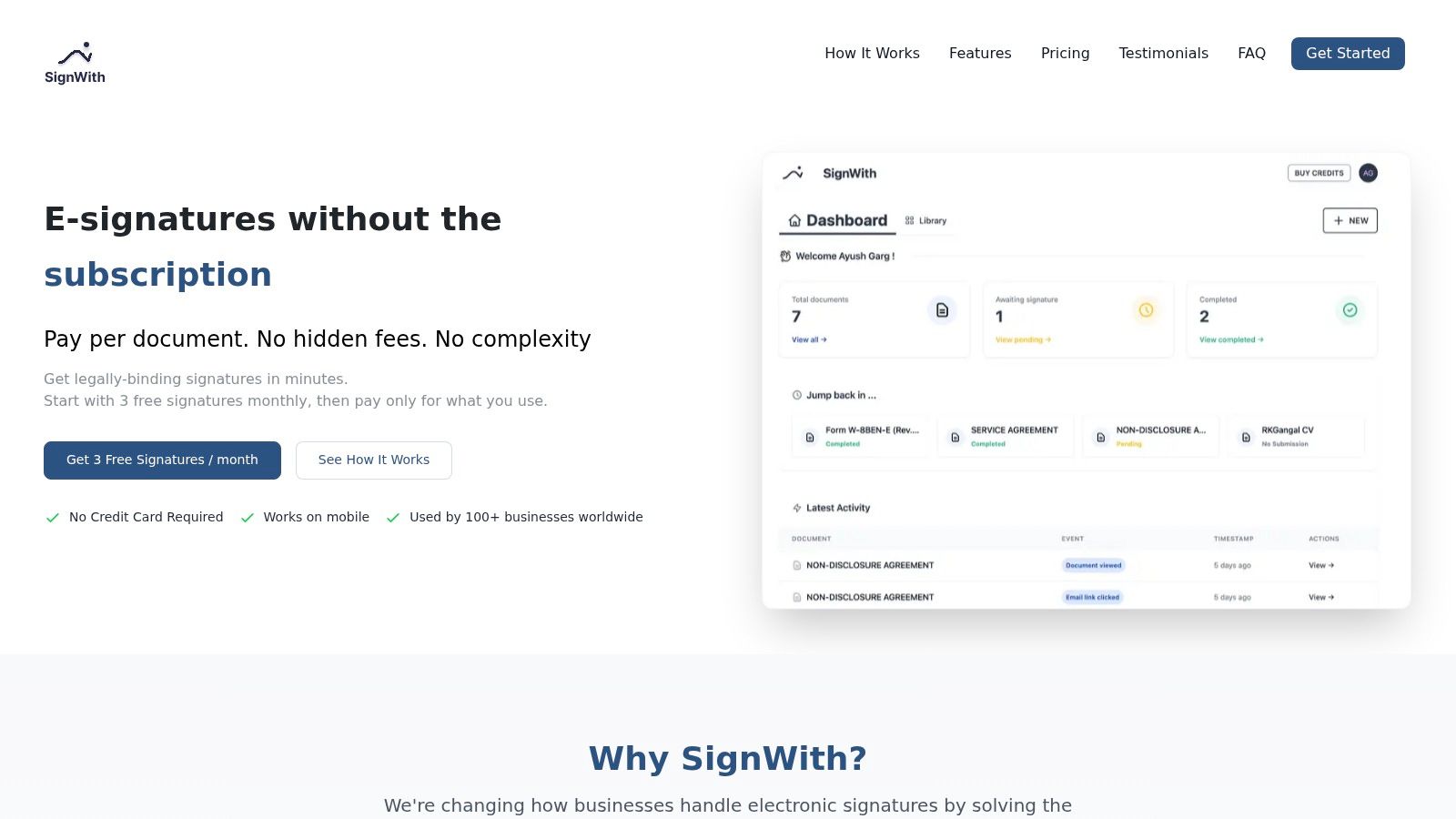
The smartest signing process is the one that removes friction without weakening compliance. For U.S. compliance, SignWith is complied with USA standard for e-signature - ESIGN Act & UETA. That's the standard that matters under compliances here.
According to ESIGN compliance best practices, institutions must prohibit consumers from advancing past the disclosure screen until they've received the ESIGN disclosure and given explicit consent. That sequencing matters because consent has to come before electronic document delivery.
That's one reason serious teams prefer structured e-signature workflows over casual “type your name in a PDF and email it back” habits. A proper process gives you cleaner records, clearer completion steps, and less back-and-forth.
If you handle recurring agreements, sales paperwork, or client approvals, this guide to e-signatures for sales contracts is worth reviewing because the operational issues are similar even when the document type changes.
A contract isn't really finished when you draft it. It's finished when both parties can prove what they signed, when they signed it, and what version they agreed to.
Your Next Step Toward Professional Confidence
A service contract isn't legal theater. It's a working tool. It helps you price correctly, define the work, protect your time, and keep client relationships steady when projects get messy.
That's why learning what is a service contract matters so much for freelancers and small businesses. Once you understand the difference between a standard B2B agreement, a consumer repair contract, and a government service contract, a lot of confusion disappears. You stop borrowing the wrong language for the wrong job.
You also get more confident in ordinary business moments. Sending a proposal feels cleaner. Revising scope feels less awkward. Asking for signature feels professional, not pushy.
If you want a practical refresher on the last mile of execution, this guide on how to sign a contract securely is a helpful companion to the drafting side. And if you're building a repeatable process for a growing company, this overview of eSignature software solutions for SMEs can help you think through the operational side.
The next time a client says, “We can just work it out over email,” you'll know better. You can still be friendly. You can still be flexible. You just won't be informal about the parts that protect your business.
If you're ready to make client agreements easier to send, sign, and store, SignWith gives you a simple way to handle signatures without subscription bloat. It's built for practical business use, with pay-per-document pricing, audit-trailed signing, and compliance aligned with U.S. e-signature standards under ESIGN Act and UETA.
