
You send a proposal, the client signs it, and work begins. Weeks later, after you've done the hard part, an email arrives: they've “changed direction,” they “won't be moving forward,” and they “won't be paying the balance.” If you run a small business, that message doesn't feel like a routine dispute. It feels like the other side has stepped away from the deal entirely.
That's where repudiation of contract matters. It's the law's way of dealing with a party who clearly communicates that they won't do what they promised. For a freelancer, consultant, agency owner, contractor, or seller, the issue usually isn't just legal theory. It's practical: what exactly did they say, what did they do, what proof do you have, and what should you do next?
Many business owners get stuck at this point. They know something is wrong, but they're not sure whether they're dealing with a late payment, a messy misunderstanding, or a legally meaningful refusal to perform. In modern business, that answer often lives inside email threads, Slack messages, text messages, signed PDFs, and audit trails.
Table of Contents
They Said They Won't Pay Now What
You finish a branding project. The client approved the concept, signed the agreement, and met with you through every milestone. Then they send a short note saying they've changed priorities and won't make the final payment.
That's the moment many owners make a costly mistake. They argue about tone, fairness, or the client's business judgment, when the actual question is simpler: did the other side clearly refuse to do what the contract required?
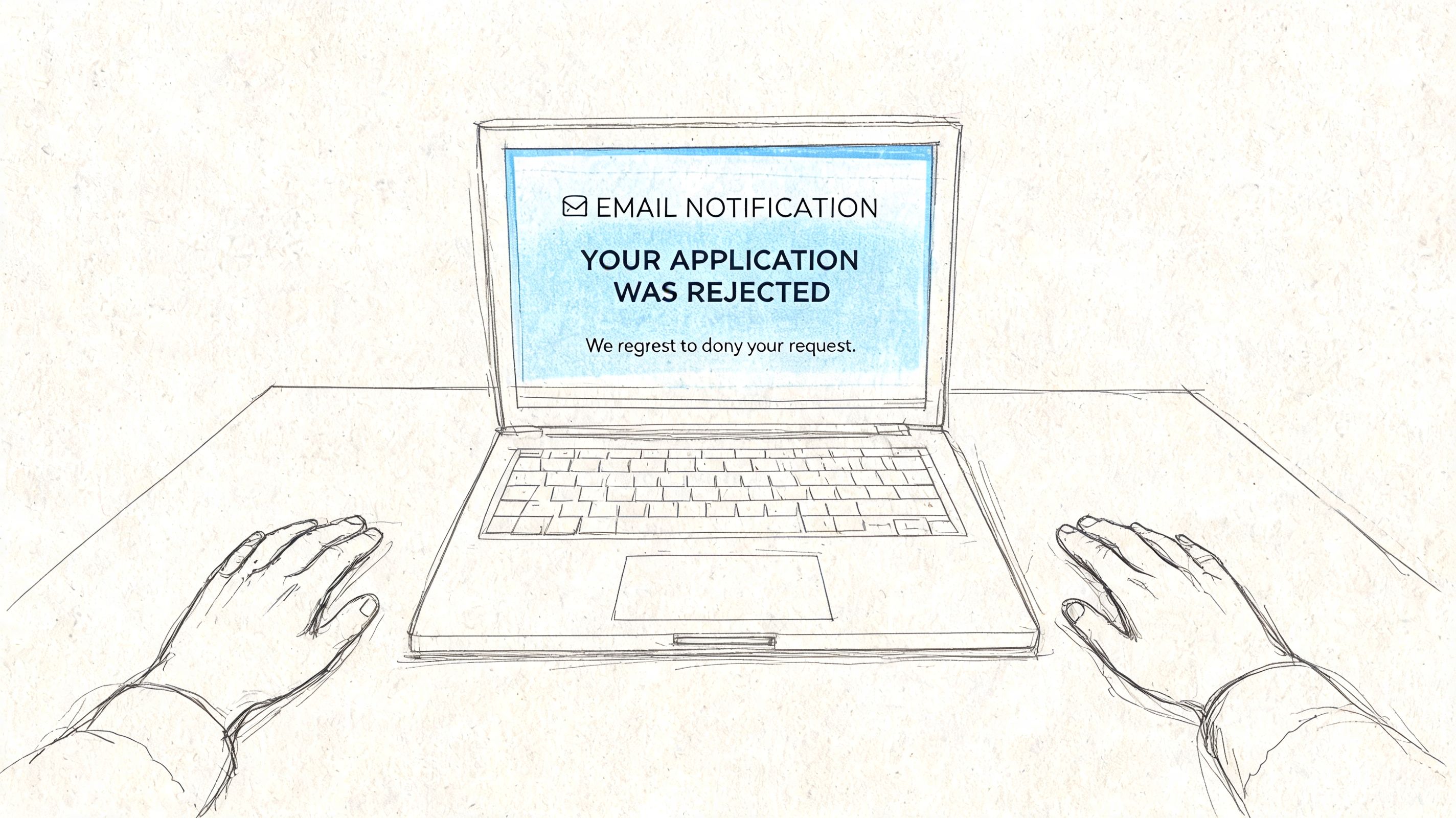
If you sell services, this can show up as a cancellation message after work has started. If you sell goods, it might be a buyer saying they won't accept delivery. If you rely on suppliers, it can look like a vendor announcing they won't ship what they promised.
A signed agreement helps, but your evidence often extends beyond the contract itself. Approval emails, milestone confirmations, change requests, and the original execution record all matter. If your deals are signed electronically, a clear signing process can make later disputes easier to sort out. Businesses that use e-signatures for sales contracts often find that the true value isn't just speed. It's the paper trail.
Practical rule: When the other side says they won't perform, don't answer emotionally first. Preserve the message, gather the contract, and line up the timeline.
Repudiation of contract isn't every disagreement. But when it applies, it changes your position quickly. You may have rights before the original deadline arrives, and your next move can affect whether you strengthen your claim or muddy it.
What Is Repudiation of Contract The Core Legal Test
A repudiation of contract is not just poor performance. It's a clear, unequivocal refusal to perform, or conduct that objectively shows the party no longer intends to be bound before performance is due, as explained in ConsensusDocs on the distinction between anticipatory breach and repudiation.
What makes it different from an ordinary breach
Think of a contract like a flight booking. If the plane is delayed, the trip is disrupted, but the airline still plans to fly. If the airline tells you the route is canceled and there will be no replacement flight, that's a different category of problem.
Contract law works in a similar way. A late payment, missed milestone, or sloppy draft may be a breach. But repudiation usually requires something stronger: a communication or action that tells a reasonable person, “I'm not doing this deal.”
That matters because once repudiation is established, the innocent party can usually act right away instead of waiting for the due date to pass. In business terms, this can affect termination rights, damage claims, staffing decisions, substitute vendors, and your duty to limit losses.
What usually does not count
Readers often get tripped up here. These situations may feel serious, but they usually don't amount to repudiation by themselves:
A delay: “We need another week.”
A complaint: “This project is costing more than expected.”
A renegotiation attempt: “Can we revise the payment schedule?”
Hesitation or silence: “We're reviewing internally.”
Those signals may still matter. They may justify closer monitoring, tighter documentation, or a request for clearer commitment. But they usually aren't enough unless they turn into an unconditional refusal.
The word that matters most is unequivocal. If the message leaves real room for performance, a court may treat it as uncertainty rather than repudiation.
Here's a simple comparison:
| Situation | Likely category |
|---|---|
| “We're behind and need more time.” | Delay or possible breach |
| “We want to discuss revised pricing.” | Renegotiation request |
| “We will not deliver the software.” | Likely repudiation |
| Seller disposes of the only equipment needed to perform | Possible implied repudiation |
For small business owners, the takeaway is practical. Don't label every ugly email a repudiation. But don't ignore a direct refusal either. The wording, the surrounding conduct, and the timing all matter.
Express Versus Anticipatory Repudiation
Repudiation usually appears in two business-friendly categories: express and anticipatory. The labels sound technical, but the difference is straightforward.
Express repudiation
This is the easy one to spot. The other party says, in plain words, that they won't perform.
Examples include:
A client email: “We are canceling and will not pay the remaining invoices.”
A supplier message: “We won't be delivering your order.”
A contractor statement: “We're done with this project and won't return.”
The strength of an express repudiation is that the evidence is often sitting right in the message itself. If it's written clearly and sent to you directly, the dispute shifts from “what did they mean?” to “what are you going to do about it?”
Anticipatory repudiation
This happens before performance is due. The law has recognized this idea for a long time. A foundational milestone is Hochster v. De la Tour (1853), widely treated as the starting point of the modern doctrine of anticipatory repudiation. Later legal development carried the doctrine into American law and into major commercial frameworks such as the UCC, the Restatement, the Restatement (Second), and the CISG, as described in this legal history of anticipatory repudiation.
For a business owner, the key point is practical. You don't always have to sit still until the deadline passes if the other side has already made clear they won't perform.
Why timing changes your leverage
Suppose a consultant is supposed to lead your product launch next quarter. Today they tell you they've taken another role and won't be available. The service date hasn't arrived yet, but the problem is already real. You may need a replacement now, not later.
That's why anticipatory repudiation exists. It recognizes that waiting can make losses worse.
An effective perspective to consider is:
Express repudiation focuses on how clearly the refusal is communicated.
Anticipatory repudiation focuses on when that refusal happens, namely before performance is due.
Sometimes the same conduct is both. An email saying, “We will not ship your order next month,” is an express refusal delivered in advance. In that sense, it's express and anticipatory at once.
If the contract matters to your cash flow, timing isn't a side issue. Timing is often the entire business problem.
Repudiation in the Real World Cases and Examples
Law gets clearer when you see it in action. One older case still captures a lesson many business owners miss: what you do after the repudiation can matter almost as much as the repudiation itself.
What an old case still teaches business owners
In Wester v. Casein Co. (1912), a court initially treated a message as a complete repudiation. But the later treatment of the dispute was affected because the non-breaching party accepted performance after the repudiation. The historical record is important because it shows a continuing rule point in American contract law: a repudiation can be affected, and sometimes effectively negated, by later conduct such as acceptance of performance, as discussed in the Michigan Law Review treatment of the case history.
That catches many owners off guard. They receive a message that sounds final, but then they keep performing, keep accepting work, or keep acting as if the deal is still fully alive. Later, the record looks mixed.
Three business examples
Here's how repudiation of contract often shows up in modern small business life.
Example one. A website designer finishes phase one under a signed proposal. The client replies, “We've canceled this initiative internally and won't be moving forward or making further payments.” That's the classic express form.
Example two. A specialized launch consultant is booked for a future campaign. Before the launch date, the consultant says they've committed elsewhere and won't be available for your project. The date hasn't arrived, but the refusal has.
Example three. A manufacturer promised to make your custom parts using a particular mold. You discover they sold the mold and have no replacement plan. They may never have written “we refuse,” but their conduct can speak loudly.
Here's the practical comparison:
| Scenario | Evidence likely to matter most |
|---|---|
| Direct cancellation email | The wording of the message and the signed contract |
| Refusal before due date | Message date, contract deadline, surrounding communications |
| Conduct making performance impossible | Records showing the party put performance out of reach |
A court often looks at the full sequence, not one isolated sentence. Save the contract, then save the thread.
For owners, the lesson from both old cases and modern examples is simple. Don't just ask whether the other side said something dramatic. Ask whether your own follow-up actions support or weaken your position.
Your Options When Faced with Repudiation
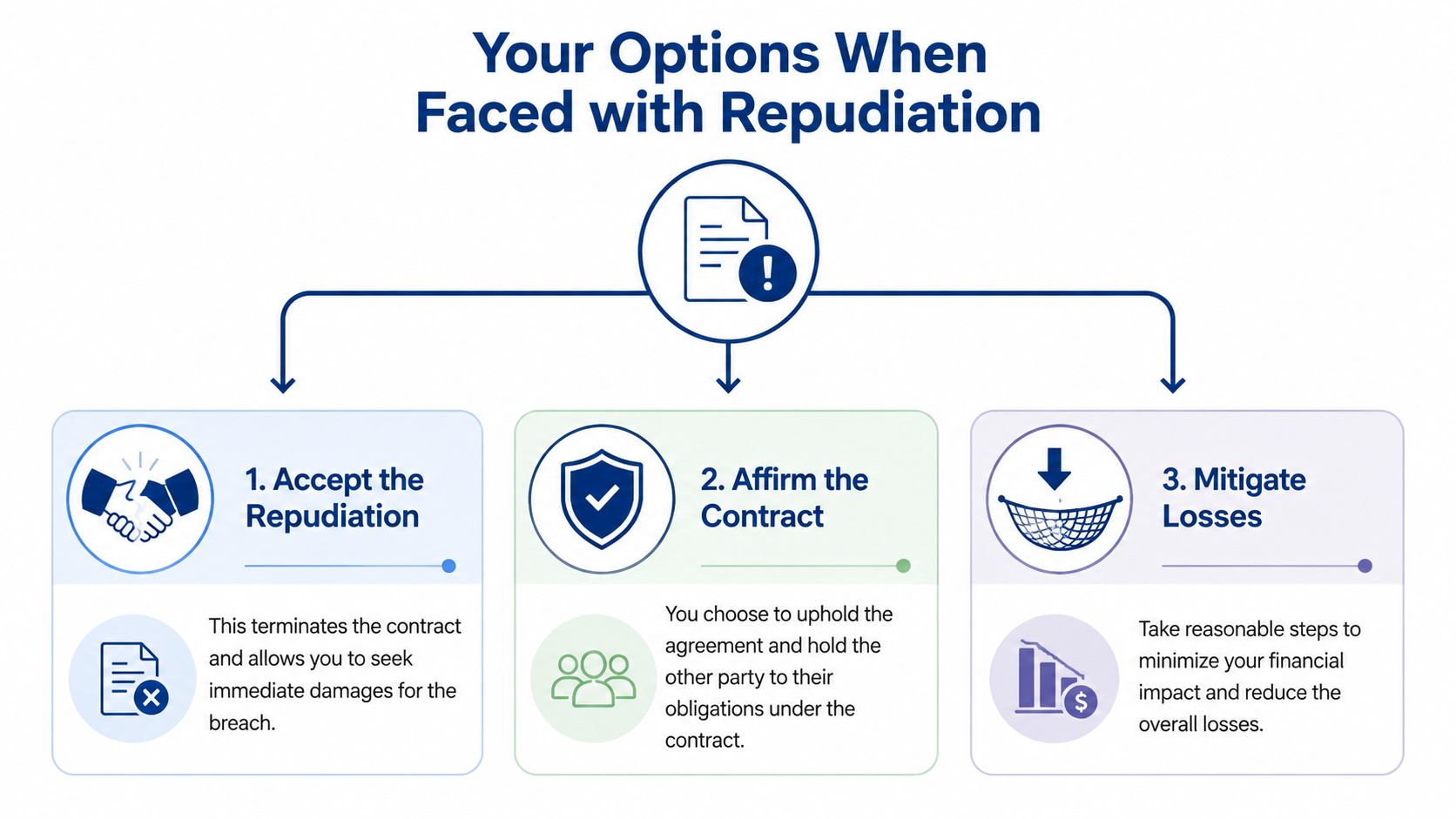
Once repudiation is on the table, you are making a business decision as much as a legal one. Your response can shape your losses, your bargaining position, and the evidence record.
If your operation runs on signed proposals, work orders, vendor agreements, or onboarding paperwork, the ability to manage those documents cleanly matters long before a dispute starts. Many owners looking at eSignature software solutions for SMEs are really trying to solve that larger problem: consistency, visibility, and proof.
Option one accept it and stop performing
This is the cleanest route when the refusal is obvious. You treat the contract as terminated, stop your own future performance, and preserve your claim for damages.
This path often makes sense when:
The message is direct: “We will not pay” or “we will not deliver.”
Continuing work would increase your losses: more labor, more materials, more overhead.
You can replace the deal or reallocate resources: take another client, source another vendor, fill production capacity elsewhere.
If you choose this route, mitigation matters. In plain language, that means taking reasonable steps to limit your losses rather than letting them grow.
Option two keep the contract alive for now
Sometimes the other side sends a hard message and then wavers. You may decide not to accept the repudiation immediately. Instead, you continue to hold them to the contract for a commercially reasonable period and see if they perform.
This can be useful when the contract is strategically important and performance is still possible. But it carries risk. Market conditions can change, replacement options can disappear, and your conduct can create confusion about whether you accepted the refusal or not.
A short internal checklist helps here:
Can they still realistically perform?
Will waiting increase your costs?
Have you preserved your rights in writing?
Will continued cooperation blur the record?
Option three ask for clarity and proof of performance
The hardest cases are the gray ones. The other side sounds shaky, but not final. They stop responding, hint at financial problems, or ask for major changes without quite saying they're out.
That's where owners should think in evidence, not emotion. Ask for a written confirmation of intent to perform. Ask them to confirm deadlines, delivery dates, payment dates, or staffing commitments. Be specific.
A practical request might ask:
Whether they still intend to perform in full
The date by which they will perform
Who will be responsible for delivery
Any reason performance is at risk
Business instinct matters here: if the other side is vague, make your questions precise.
The modern challenge is that many disputes unfold across multiple channels. One person sends an optimistic email, another sends a hesitant Slack message, and a finance contact goes silent. A useful angle emphasized in Quimbee's discussion of anticipatory repudiation and adequate assurances is the evidentiary question: what digital proof turns hesitation into a clear, communicated refusal? That's the question owners should be asking early.
Prevention How to Draft Contracts That Protect You
The best repudiation dispute is the one you made easier to prove before it happened. Good contracts don't prevent every breakdown, but they reduce ambiguity and create a cleaner record.
Write the contract so proof is easier later
Small business contracts often fail in ordinary ways. They describe the scope loosely, leave dates fuzzy, and say very little about what happens if one side starts wobbling. That creates room for arguments later.
A stronger agreement usually includes:
Specific deliverables: define what is being provided in concrete terms.
Clear timing: spell out milestones, due dates, approval windows, and payment triggers.
Communication rules: identify where formal notices must be sent.
Termination language: explain when a party may end the deal and what follows.
Evidence-friendly wording: require changes and approvals to be documented in writing.
If you want a practical starting point for execution itself, this guide on how to sign a contract electronically is useful because execution procedure often becomes part of the proof story later.
Here's a simple drafting lens:
| Contract element | Why it matters in a repudiation fight |
|---|---|
| Defined scope | Helps show what performance was actually owed |
| Milestones and dates | Helps show whether refusal came before or after performance was due |
| Written notice clause | Helps identify which messages count |
| Payment triggers | Helps separate a billing dispute from a total refusal |
Build a digital evidence trail on purpose
Most modern repudiation disputes are document disputes. The hard question usually isn't whether business relations soured. It's whether the digital record shows a clear, communicated refusal rather than confusion, delay, or negotiation.
That's why execution records matter. A properly documented e-signature process gives you a fixed starting point: who agreed, when they agreed, and what document they agreed to. From there, later emails, text messages, or chat logs can be measured against a confirmed baseline.
The useful insight here is practical, not flashy. Many articles explain the doctrine, but they don't answer what evidence really moves the issue. The key is documenting the refusal in a way that makes it look final and communicated. As noted in the earlier Quimbee reference, e-signature audit trails are valuable because they establish the initial agreement and help show that a later cancellation message is a genuine departure from that agreed obligation.
A clean digital evidence file often includes:
The signed contract PDF
The audit trail or completion certificate
Approval emails tied to milestones
Change requests and responses
Any message that uses final language like “will not,” “cannot,” or “canceling”
A timeline showing when the refusal was sent relative to the due date
Here's a useful explainer on electronic signing workflow and documentation:
One compliance point is worth keeping straight. If you use an e-signature platform for U.S. business contracts, you want one that complies with the ESIGN Act and UETA. That doesn't decide every repudiation dispute by itself, but it strengthens the foundation of your proof.
Don't wait until a dispute starts to care about records. By then, the missing evidence is usually already missing.
Conclusion Repudiation Is a Crossroads Not a Dead End
Repudiation of contract feels dramatic because it is. When the other side clearly refuses to perform, the relationship changes fast. But that doesn't mean you're stuck.
What matters is recognizing the difference between a messy contract problem and a true refusal to perform. Once you spot that difference, your response becomes more deliberate. You can decide whether to accept the repudiation, hold the contract open briefly, or push for written clarity when the signals are still mixed.
For small business owners, the bigger lesson is about proof. In modern disputes, email wording, chat logs, signed documents, and audit trails often decide whether hesitation looks like mere confusion or a legally meaningful break from the deal. Clear contracts and disciplined documentation give you options when the other side stops acting like a partner.
A repudiation is a crossroads. It's serious, but it isn't the end of the road if you've built your agreements and records the right way.
If you want a simple way to create legally binding electronic contracts with detailed audit trails, SignWith is built for that. It supports U.S. compliance with the ESIGN Act and UETA, keeps signing straightforward for small businesses, and gives you the kind of clean execution record that becomes valuable when a deal later goes sideways.
