
You're probably here because a simple question turned out not to be simple at all.
A school trip is coming up and a child's parent is out of town. A small clinic needs approval before a minor procedure. A caregiver wants to help an older relative, but isn't sure whether they can legally sign. Someone pulls up a “medical consent form” template online, and suddenly important questions arise. What exactly does this authorize? Who's allowed to sign it? Does it cover treatment, records, and payment, or only one of those?
That's where people get stuck. They think they need a form, when what they really need is a clear process.
A medical consent form is best understood as a written record of a conversation and a decision. It helps the person receiving care understand what's being proposed, what the main risks and expected benefits are, what alternatives exist, and whether saying yes is voluntary. It also gives the clinic, school, caregiver organization, or small business a defensible record of what was disclosed and accepted.
If you handle health-related paperwork, it helps to think of consent the same way you'd think about privacy controls or access permissions. One document may support the workflow, but the legal meaning depends on what is being authorized and by whom. Teams dealing with patient data often run into a similar issue when sorting out operational processes and privacy requirements. This practical guide to navigating HIPAA compliance for CRMs in Canada is useful for that broader mindset, especially if your organization touches both records and consent administration.
Table of Contents
- What Is a Medical Consent Form Really For
- Anatomy of an Effective Medical Consent Form
- Not All Consent Is Created Equal Key Form Types
- The Critical Question of Signing Authority
- Modernizing Consent with E-Signatures
- Drafting and Presenting Consent Forms for Clarity
- Your Medical Consent Form Questions Answered
What Is a Medical Consent Form Really For
A medical consent form isn't just paperwork. It's evidence that a person had enough information to make a voluntary decision about care.
Think about a school office before a field trip. Staff members may have emergency contacts, allergy notes, and insurance details. None of that automatically gives the school the power to authorize treatment in every situation. The consent form fills a different role. It identifies who may authorize care, what kind of care is covered, and under what conditions action can be taken.
The same applies in a small clinic. A patient doesn't walk in, sign a page, and magically make everything lawful. Consent only works when the person signing understands what they're agreeing to and has the authority to agree.
Practical rule: A signature records consent. It doesn't create understanding by itself.
That distinction matters because people often treat consent forms like intake forms. They are not the same thing. An intake form gathers facts. A medical consent form documents permission after disclosure.
Consent is a process, not a checkbox
In regulated research settings, federal rules make this especially clear. U.S. federal guidance under the Common Rule and FDA regulations requires nine basic informed consent elements for research participation, including the purpose, expected duration, procedures, risks, benefits, alternatives, and confidentiality protections, according to Prisma Health's summary of required informed consent elements. That framework is for research, but it gives everyone a useful lesson. Consent is a structured disclosure process, not just a signed page.
Here's a simple analogy. If you lend someone your car, “yes” means little unless both of you understand which car, for how long, and under what conditions. Medical consent works the same way, except the stakes are much higher.
Why both patients and organizations need it
A strong consent process protects autonomy first. It gives patients, parents, and lawful caregivers the chance to say yes, no, or not yet.
It also protects the organization handling care. If a dispute happens later, the question usually isn't “Was there a form somewhere?” It's “What was explained, who agreed, and were they allowed to agree?” A well-built medical consent form helps answer all three.
For small businesses and caregivers, that's the big shift in mindset. Don't start with the template. Start with the decision you need to document.
Anatomy of an Effective Medical Consent Form
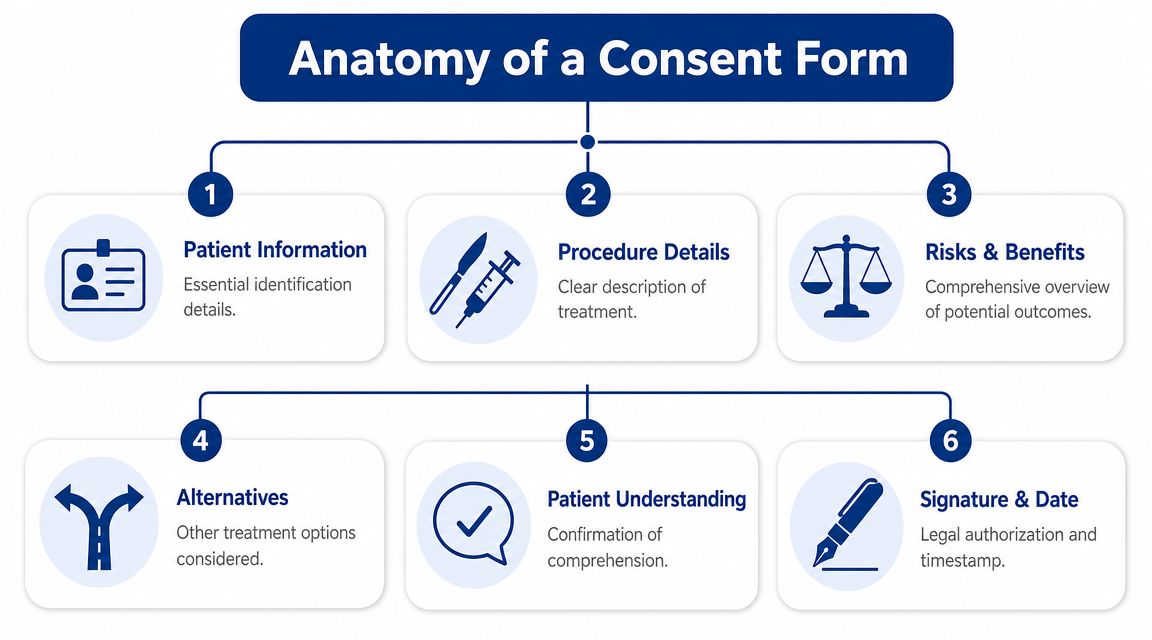
A useful medical consent form works like a clear set of directions before a serious decision. A parent, caregiver, or patient should be able to scan it and answer four practical questions without guessing: Who is this for? What care is being proposed? What are the main risks and options? Who is giving permission?
That last question trips people up often. A form can describe treatment well and still fail if it does not clearly show whether the signer is the patient, a parent, a legal guardian, or another adult acting under written authority.
This visual captures the core structure.
The required elements
Most forms need the same basic parts, even if the wording changes by clinic, school program, home care setting, or procedure. The easiest way to understand them is to read the form as a record of one specific decision, not as a catchall permission slip.
- Patient identification. Name the patient clearly so the document cannot be confused with someone else's chart or family member.
- Treatment or procedure description. Say what is being proposed in plain language. Medical terminology can appear too, but the everyday explanation should come first.
- Main risks and expected benefits. Explain the serious downsides a reasonable person would want to know, along with the likely purpose of the treatment.
- Alternatives. List other available paths, including waiting, choosing a different treatment, or refusing care.
- Statement that consent is voluntary. The form should make clear that the signer can ask questions before agreeing.
- Signature and date fields. Record who signed, when they signed, and, where relevant, what authority they had to sign.
One practical upgrade makes many forms stronger. Add a separate line for the signer's relationship to the patient, such as parent, legal guardian, adult patient, health care proxy, or caregiver with written authorization. That small field can matter just as much as the signature itself months later.
Why structure matters as much as wording
A consent form should read like labeled compartments in a toolbox. If treatment details, billing promises, HIPAA acknowledgments, and records release language are all packed into one block of text, people often sign without understanding which part authorizes what.
That confusion creates legal and operational problems. Treatment consent gives permission for care. A billing form can assign financial responsibility. A records authorization governs who may disclose or receive medical information. If you want a cleaner model for that separate document, review these medical record release form best practices.
A safer layout separates identity, authority, treatment description, and signatures into distinct sections. People understand forms better when each section answers one job.
Here is a simple drafting test. Cover the heading and hand the form to someone outside your field. If they cannot quickly explain what care is being authorized and who is allowed to authorize it, the form needs revision.
| Form area | What it should answer |
|---|---|
| Patient details | Who is receiving care? |
| Signer details | Who is authorizing care, and in what legal role? |
| Treatment summary | What exactly is being proposed? |
| Risks and benefits | What are the main tradeoffs? |
| Alternatives | What other choices exist? |
| Signature record | When was consent given, and by whom? |
A quick self-audit for your current form
Use these questions before reusing any template:
- Is the treatment described clearly enough for a non-clinician? “Wound cleaning and stitches” is usually clearer than a technical label alone.
- Are the material risks visible without hunting for them? Important information should not disappear inside a dense paragraph.
- Does the form capture the signer's authority, not just their name? This matters most for minors, shared custody situations, and non-parent caregivers.
- Does each signature match one purpose? Treatment permission, billing responsibility, and records disclosure should not blur together.
- Would the form still make sense later, without the original conversation? A good consent form should stand on its own as a record of what was authorized.
The strongest forms do one job well. They document a specific decision, show who had the right to make it, and leave as little room for guesswork as possible.
Not All Consent Is Created Equal Key Form Types
People often use the phrase “medical consent form” as if it refers to one universal document. It doesn't. Different forms authorize different things, and using the wrong one can create false confidence.
This comparison makes that easier to see.
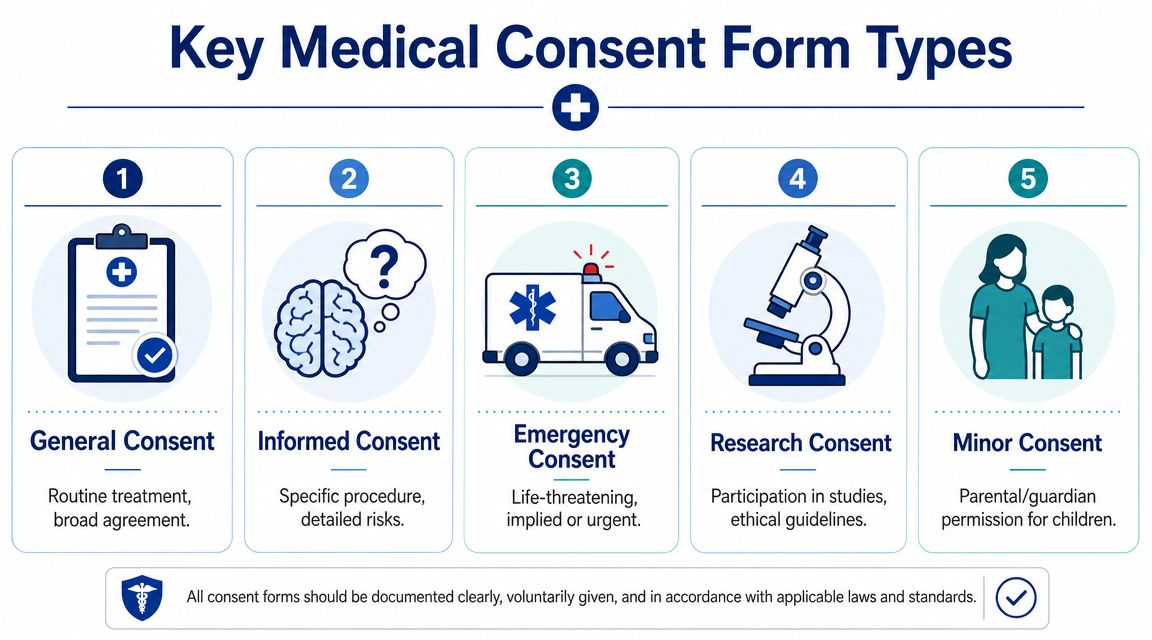
Five common categories people mix together
Some forms are broad. Others are narrow. The trick is matching the document to the decision.
| Form type | What it usually covers | Common mistake |
|---|---|---|
| General consent | Routine care and standard services | Assuming it covers every future procedure |
| Informed consent | A specific treatment or higher-risk procedure | Making it too vague |
| Emergency consent | Urgent situations where quick action is needed | Treating it like a substitute for all routine permissions |
| Research consent | Participation in a study | Using a treatment form for research |
| Minor consent | Authorization involving a child | Assuming any adult relative can sign |
The biggest confusion usually sits outside that table. People also mix up treatment consent, records access, and payment responsibility.
That isn't just a drafting issue. It's a legal one. The No Surprises Act uses a separate consent document when a patient waives certain surprise-billing protections, according to the CMS standard notice and consent forms for nonparticipating providers and emergency facilities. In plain English, permission to receive care is not automatically permission to waive billing protections.
A quick way to choose the right form
If you're unsure which form you need, ask one question first: What exactly am I trying to authorize?
- Treatment only. Use a treatment consent form specific to the care involved.
- Release of records. Use a separate authorization for sharing information.
- Financial responsibility or billing waivers. Handle these as distinct documents.
- Research participation. Use a research-specific consent process.
- Care for a minor. Confirm that the signer has the right legal role.
If one form tries to do everything, it often proves nothing well.
A caregiver may think, “I have a consent form, so I can speak to the hospital, get the child treated, and handle insurance.” Maybe. Maybe not. Those powers often live in different documents.
That's why it helps to understand adjacent paperwork too. If your workflow includes release authorizations, this guide to medical record release form best practices is useful because it shows how disclosure of information needs its own clear scope.
Real-world examples
A few examples make the distinction clearer:
- Routine pediatric visit. A clinic may rely on a general consent to treatment for standard care.
- Procedure with meaningful risk. A provider should use a more specific informed consent form that spells out the procedure, major risks, and alternatives.
- Research study enrollment. A research consent form needs a different level of disclosure and oversight.
- Out-of-network billing issue. A billing consent or waiver document may be required separately from care authorization.
When readers ask for a “template,” they're often asking the wrong question. The better question is, “What am I trying to authorize, and what should stay separate?”
The Critical Question of Signing Authority
A perfect form with the wrong signer is still a bad form.
That's the point many caregivers, schools, and small organizations miss. They spend time polishing wording, then overlook the first legal question that matters. Who has authority to sign this medical consent form?

Adults, minors, and substitute decision-makers
For a competent adult, the answer is usually straightforward. The patient signs for themselves.
Things change when the patient is a minor or can't make their own decisions. In those cases, the lawful signer may be a parent, legal guardian, healthcare proxy, or another person recognized under applicable law and the care setting's rules.
For small organizations, the safest habit is to document the signer's role explicitly. Don't leave only a signature line. Add a role field such as patient, parent, legal guardian, agent under power of attorney, or authorized caregiver.
That's not clerical fussiness. It's evidence.
Why non-parent caregiver situations need special care
Here, generic templates usually fall apart.
A child may live with a grandparent for part of the year. An aunt may be handling school pickup and doctor visits. An adult sibling may be the practical caregiver while a parent is unreachable. In daily life, these arrangements feel normal. Legally, authority still has to be checked.
Texas offers a good example of how specific these rules can get. In certain circumstances when a parent can't be contacted, Texas law allows a grandparent, adult sibling, aunt or uncle, a school, or another adult with actual care and written authorization to consent to a child's medical treatment, as explained by Texas Law Help's guide to non-parent consent for medical treatment.
That doesn't mean the same rule applies everywhere. It means you can't assume a relative has authority just because they're involved.
A family relationship and legal signing authority are not always the same thing.
For schools, camps, small care programs, and community organizations, this is often the most important lesson in the whole topic.
Here's a practical screening list before accepting a non-parent signature:
- Check the relationship. Is the signer a grandparent, sibling, aunt, uncle, foster caregiver, school representative, or another adult?
- Ask what gives them authority. Written authorization, guardianship, court order, policy-based authority, or state-specific rule.
- Match authority to the decision. Permission for routine treatment may not include access to records or responsibility for payment.
- Record the role on the form. Don't leave future readers guessing.
- Escalate unusual cases. If the situation involves minors, multiple caregivers, or conflicting instructions, legal review is worth it.
If your team already handles documents that require role-based signatures, the same discipline applies here. This article on e-signature workflows for HR professionals is useful because HR teams face a similar challenge. The document is only reliable if the right person signs in the right capacity.
Modernizing Consent with E-Signatures
A caregiver arrives with a sick child five minutes before closing. The form is signed, but the date is missing, one page is blank, and nobody can tell whether the signer approved treatment, billing, or both. Paper creates that kind of confusion all the time.
A well-designed digital workflow can prevent it. The goal is not merely to swap pen and paper for a screen. The goal is to preserve a clear record of who agreed to what, in what role, and when.
What digital consent solves
Digital consent works like a dated receipt combined with a checklist. Instead of relying on a stack of pages that can be scanned out of order or filed under the wrong name, you keep one organized record from start to finish.
That matters in real settings. A clinic may need proof that a parent approved treatment but did not agree to optional financial terms. A school nurse may need to confirm that a grandparent signed as an authorized caregiver, not as the child's legal guardian. Paper packets often blur those lines because they gather one signature at the end and leave too much open to interpretation.
A better e-sign process separates those steps. It can present treatment consent, privacy acknowledgments, and payment-related authorizations as distinct items, so the final record shows each approval clearly.
What a defensible e-sign workflow should capture
If you move a medical consent form online, use the format to make the record clearer, not just faster.
Look for a workflow that captures:
- Signer identity. The person who signed.
- Signer role. Patient, parent, legal guardian, proxy, or non-parent caregiver.
- Timestamped execution. The date and time consent was given.
- Separate acknowledgments. A record of which disclosures or permissions were accepted.
- Archived final copy. A completed version staff can retrieve later without guessing which draft was used.
In the United States, electronic signatures are generally valid under the ESIGN Act and UETA when used properly. For a small practice, school, or care program, that usually sets the baseline question. Can you show that the signer intended to sign, received the document, and completed the process in a way you can later verify? If your team needs a plain-English explanation of terminology, this guide to digital signature vs electronic signature gives a useful starting point.
Digital consent is strongest when it records the decision process clearly, not just the final signature.
For occasional workflows, some teams also use tools that let them e-sign your PDFs without adding a large software system. The label on the tool matters less than the record it produces.
Electronic signing does not solve the underlying legal question of authority. You still need the correct person to sign, especially when the patient is a minor and the adult present is not a parent. What digital signing does well is reduce missing fields, separate different kinds of consent, and keep a cleaner file if that decision is ever questioned later.
Drafting and Presenting Consent Forms for Clarity
Many consent forms fail for a simple reason. They were written for lawyers and file cabinets, not for tired parents, anxious patients, or staff working a front desk.
Clear drafting has become more important, not less. A major milestone came when the revised U.S. Common Rule took effect on January 21, 2019, requiring research consent documents to begin with a “concise and focused” key information section. That section must cover core points such as that participation is research and voluntary, the purpose and duration of the study, procedures, foreseeable risks, expected benefits, and alternatives when applicable, according to George Washington University's summary of the Common Rule key information requirement.
Even if you don't handle research, that shift offers a practical lesson. Put the most important decision-making information first.
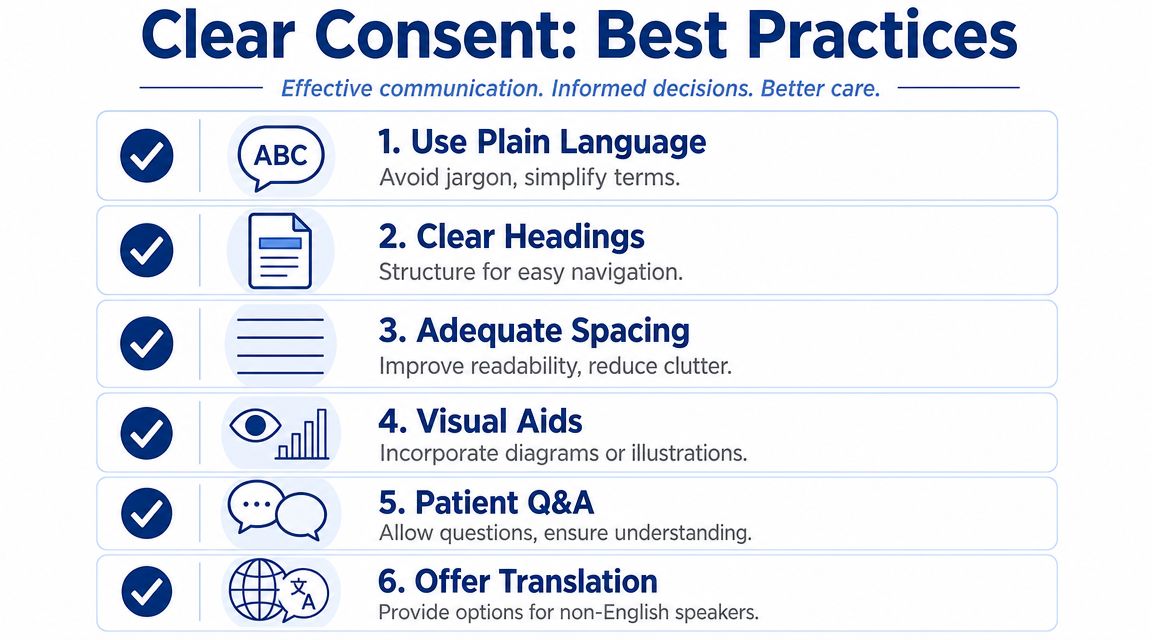
Write for the signer, not the file cabinet
A useful consent form should be skimmable on the first pass and understandable on the second.
Try these drafting habits:
- Use everyday words. Replace technical terms with common-language explanations when possible.
- Front-load the key points. Put the decision summary near the top.
- Break up long paragraphs. Dense text makes people sign first and read never.
- Separate topics cleanly. Treatment consent, privacy permissions, and payment language shouldn't blur together.
- Leave room for specifics. Generic wording weakens proof that the signer understood this situation.
One easy test is the “kitchen table test.” If a caregiver could explain the form to another adult at home without translating every sentence, the draft is probably in decent shape.
Present the form like a conversation
Presentation matters as much as wording. A clear form delivered badly can still produce bad consent.
Use a process like this:
- Pause before the signature. Give the signer time to read.
- Invite questions. People often stay quiet because they think the form is routine.
- Confirm the signer's role. Especially important when minors or proxies are involved.
- Document any custom explanation. If staff clarify something material, record that in the chart or workflow.
- Store the final version carefully. An organized record matters later.
- Plan for withdrawal or updates. If consent changes, the file should reflect that.
If you're preparing forms in PDF format, this guide on how to add a digital signature block to a PDF can help with the mechanics, but the bigger issue is still clarity.
“The best consent form is the one a stressed signer can still understand.”
For higher-risk procedures or state-specific situations, customization may also be necessary. That may affect wording, signature steps, witness requirements, or storage practices. A form should be easy to read, but it also has to fit the legal setting where it will be used.
Your Medical Consent Form Questions Answered
A lot of questions show up only after someone starts using the form. That's normal. Consent lives in real life, where grandparents step in, appointments change, and emergencies don't wait for perfect paperwork.
Common questions from caregivers and small organizations
Is one medical consent form good forever?
Usually, no. Some forms are tied to a single procedure or episode of care. Others may support ongoing routine treatment for a period set by the organization or the circumstances. The safest approach is to define scope clearly on the form itself instead of assuming it covers all future care.
Can someone revoke consent after signing?
Often, yes. A signed form is not magic. If a patient or lawful decision-maker changes their mind, the organization should have a process for documenting that change and making sure staff know consent has been withdrawn or limited.
Does a treatment consent form also allow access to records?
Not automatically. Treatment authorization and information-sharing authority are often separate. If someone needs the ability to receive records or discuss protected information, that usually requires separate documentation and legal review of the role involved.
Can a relative sign for a minor just because they're helping?
Not necessarily. Real-world caregiving and legal signing authority don't always match. You need to check the applicable state law, the care setting's rules, and any written authorization or guardianship documents.
What happens in an emergency?
In life-threatening situations, providers may rely on emergency principles that allow urgent treatment when immediate action is needed and formal consent cannot be obtained in time. That exception doesn't turn emergency practice into a substitute for proper routine consent procedures.
Do higher-risk situations need extra signing steps?
Often, yes. Guidance for higher-risk or procedure-specific use notes that consent forms may need state-specific customization and stronger identity controls such as witness signatures or notarization in some situations, especially for minors, powers of attorney, or other authorization documents, as discussed in this overview of medical consent forms and identity validation practices.
Are electronic signatures valid on medical consent forms?
In the United States, they generally can be, when the process follows the ESIGN Act and UETA and the recordkeeping is handled properly. The legal validity of the signature doesn't fix a bad form or an unauthorized signer, though. Those still have to be right.
What's the biggest mistake people make?
They download a generic template and treat it like a solution. In reality, the hard parts are deciding what the form authorizes, who has the authority to sign, and how the organization will prove what happened later.
A good medical consent form is less like a blank sheet and more like a controlled handoff. It tells everyone who can decide, what they're deciding, and how that decision gets preserved.
If you need a simple way to send, sign, and store consent documents online, SignWith is built for straightforward e-signature workflows without subscriptions. It supports legally binding electronic signatures in line with the ESIGN Act and UETA, keeps an audit trail, and works well for small teams that need a practical way to manage forms without unnecessary complexity.
