
You may be sitting at a kitchen table with a yellow pad, a mortgage statement, and two very different goals in mind. You want the divorce to stay civil, and you want the paperwork to stop becoming tomorrow's problem. That's where a well-written divorce agreement contract earns its value.
In practice, many separating couples aren't fighting about whether they need an agreement. They're struggling with how detailed it needs to be, what happens if life changes after signing, and whether a clause that sounds fair today will still hold up later. Those are the right questions.
Most divorce cases in the United States are eventually settled by agreement rather than a full trial, and once the spouses sign and the court incorporates that agreement into the final decree, it functions as both a private contract and a legally binding court order, as noted by the Ohio State Bar's divorce and dissolution guidance. That dual role is why careful drafting matters so much. You're not just writing down intentions. You're setting terms a court may later enforce.
If emotions are still running high, some couples benefit from support outside the legal process while they work through decisions. For people trying to communicate more clearly during separation, this guidance for struggling couples in Kelowna can be a useful adjunct to mediation or legal planning.
Table of Contents
- Navigating Your Separation with a Clear Roadmap
- Understanding the Core Components of Your Agreement
- The Drafting Process From Negotiation to Paper
- Key Clauses That Future-Proof Your Agreement
- Reviewing and Finalizing Your Divorce Contract
- Legally Executing Your Agreement with E-Signatures
Navigating Your Separation with a Clear Roadmap
An amicable separation still needs structure. I've seen couples agree in principle on nearly everything, then stall for weeks because no one has turned those understandings into a document that answers practical questions: Who keeps the house? Who refinances? What date does support begin? What happens to joint credit cards?
A divorce agreement contract solves that problem by converting conversations into obligations. It gives each spouse a written roadmap for the post-marriage transition. Without that roadmap, even cooperative divorces drift into disputes over memory, timing, and expectations.
Practical rule: If a term matters enough to discuss, it matters enough to define in writing.
The strongest agreements don't read like emotional statements or broad promises. They read like operating instructions. They identify assets, assign debts, set deadlines, and state who must do what if a future event occurs. That kind of clarity reduces room for later argument.
Many people also assume they can “fix things later” with a text message or side conversation. That assumption creates trouble. Courts generally work from the signed agreement and the final decree, not from informal understandings that were never properly documented.
A clear agreement won't remove every stress point from divorce. It does something more realistic and more valuable. It replaces uncertainty with terms you can follow.
Understanding the Core Components of Your Agreement
A complete divorce agreement contract usually has five moving parts, even if your case feels straightforward at first. The easiest way to keep it manageable is to group those parts by function.
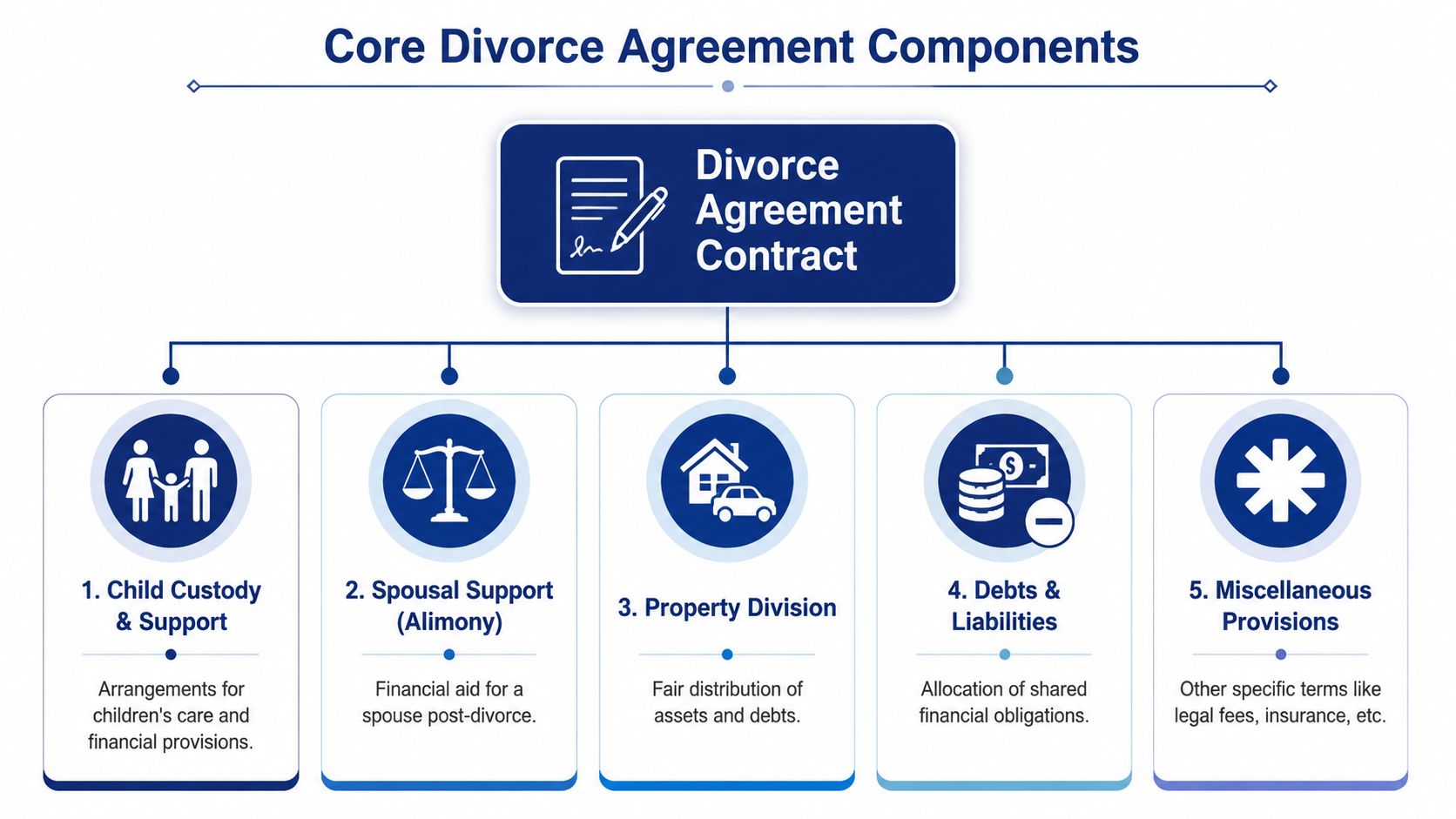
A detailed settlement agreement typically addresses property and debts, spousal support, child custody, and child support, and for agreements finalized on or after January 1, 2019, spousal support is no longer tax-deductible for the payer or taxable to the recipient in the U.S., according to DivorceNet's explanation of settlement agreements. That tax change affects how many couples frame support discussions.
If you're still organizing paperwork, a practical starting point is this guide to divorce legal forms from the Law Office of Bryan Fagan, PLLC. It's useful for seeing how different documents fit together before the agreement is finalized.
Financial division
This is usually the longest part of the agreement, and it should be the most specific. “We'll split assets fairly” is not a usable term. A court-enforceable document should identify the actual asset, who receives it, and what steps follow.
Include items such as:
- Real estate: Address title transfer, refinance responsibility, occupancy, sale timing, and who pays carrying costs until transfer or sale.
- Accounts and investments: List bank accounts, brokerage accounts, retirement plans, pensions, and any agreed division method.
- Business and personal property: Cover business interests, vehicles, furniture, tools, jewelry, collectibles, and digital assets.
- Debt allocation: Identify each loan, card, or obligation and state who pays it, by what date, and what happens if a payment is missed.
One common drafting mistake is treating debt assignment as if it automatically changes the lender relationship. It doesn't. Your agreement can allocate responsibility between spouses, but the outside creditor may still look to any person already legally obligated on the account.
Support structures
Support terms need precision, not shorthand. If one spouse will pay support, the agreement should state the amount, frequency, start date, end date, payment method, and any trigger that changes or ends the obligation. Remarriage, reconciliation, or another defined event should be handled directly rather than left for later argument.
Support provisions also need practical detail around late payments, proof of payment, and whether the parties expect review or modification if circumstances materially shift. Vague fairness language won't help if the parties later disagree about what was intended.
A support clause should answer the follow-up questions before anyone has to ask them.
Parental responsibilities
If children are involved, the parenting terms need to function in ordinary life, not just sound reasonable on paper. The agreement should address legal custody, parenting time, transportation, holiday schedules, communication expectations, and decision-making for school and health care.
Short, vague parenting language often fails because real families need logistics. Who handles exchanges. What happens during school breaks. How schedule changes are requested. The clearer the routine, the less room there is for conflict.
Complete disclosure sits underneath all three pillars. If a spouse leaves out a retirement account, business interest, digital asset, or tax liability, the agreement can become vulnerable later. An incomplete list doesn't create simplicity. It creates a delayed dispute.
The Drafting Process From Negotiation to Paper
A workable agreement starts long before anyone types “final draft.” It begins with disciplined preparation and a realistic sense of how the document will be used after the divorce is over.
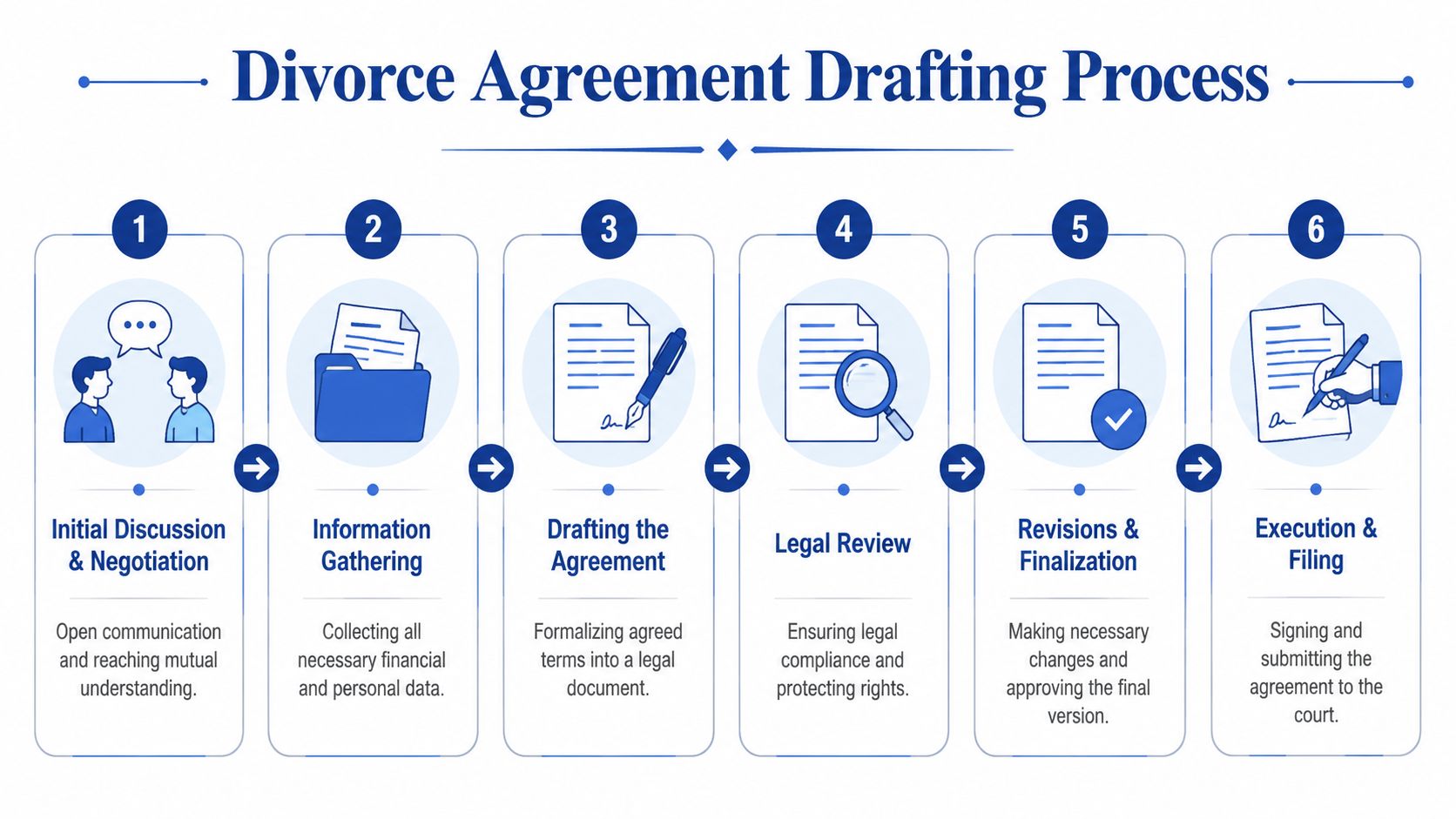
Guidance on settlement drafting stresses that a robust agreement should be written like a court-enforceable allocation schedule, with precise language listing each asset and liability, defining payment amounts and end dates, and stating what happens if future events such as remarriage occur, as outlined in Custody X Change's divorce settlement agreement guidance.
Choose the right drafting path
Not every couple needs the same process. The right path depends on how much trust remains, how complicated the finances are, and whether either spouse feels overmatched.
A few common options:
Mediator-led drafting
Best when both spouses want resolution and can negotiate with support. Mediation often helps people move from fixed positions to practical solutions, but each person should still understand the legal effect of what they accept.Attorney-negotiated drafting
Useful when there's a business, significant support issues, or a strong power imbalance. This route usually brings more structure and more protection, though it can feel slower.Pro se drafting
Some couples draft their own paperwork. This can work in a simple case, but self-drafted agreements often fail on details such as deadlines, contingencies, and enforcement language.
Negotiation works better when both spouses focus on interests rather than labels. “I need stability for the children through the school year” is easier to solve than “I refuse to move.” One identifies the problem. The other hardens the conflict.
Turn decisions into enforceable language
Once terms are discussed, the draft must translate them into plain, exact instructions. That means naming the asset, naming the responsible party, and naming the deadline.
Compare these two approaches:
| Drafting style | Result |
|---|---|
| “The parties will deal with the car loan fairly.” | Hard to enforce |
| “Spouse A will pay the car loan ending in 4421 beginning on the first day of the month after entry of the decree until paid in full.” | Clear and usable |
The same principle applies to houses, reimbursements, insurance, tuition sharing, and support.
Working standard: If a third party had to enforce the clause without hearing your past conversations, would the clause still make sense?
When you prepare the final PDF for signature, keep the signing blocks clean and consistent. If you need help formatting execution lines, this walkthrough on how to add a digital signature block to a PDF is a practical reference.
Before anyone signs, read the draft as if a disagreement has already happened. That mindset catches weak language faster than reading it as a cooperative plan.
Key Clauses That Future-Proof Your Agreement
The strongest divorce agreement contract doesn't just settle current issues. It anticipates the moments that usually reopen conflict. A refinance falls through. One spouse pays off a debt in an unexpected way. The parties make a private side deal that later unravels. Someone assumes a verbal update changed the written obligation.
That's why “future-proofing” matters. You're not trying to predict every life event. You're building a framework for handling change without collapsing into ambiguity.
A recurring problem in post-divorce disputes is that informal side agreements can weaken decree rights, which is why practitioners often recommend putting changes in writing and seeking a court-approved modification, as discussed in this analysis of side agreements after divorce in Washington.
Build for change without inviting confusion
Good modification language doesn't say merely that the parties “may revise terms later.” That's too loose. It should say how changes are made, when they become effective, and whether court approval is required for them to be binding.
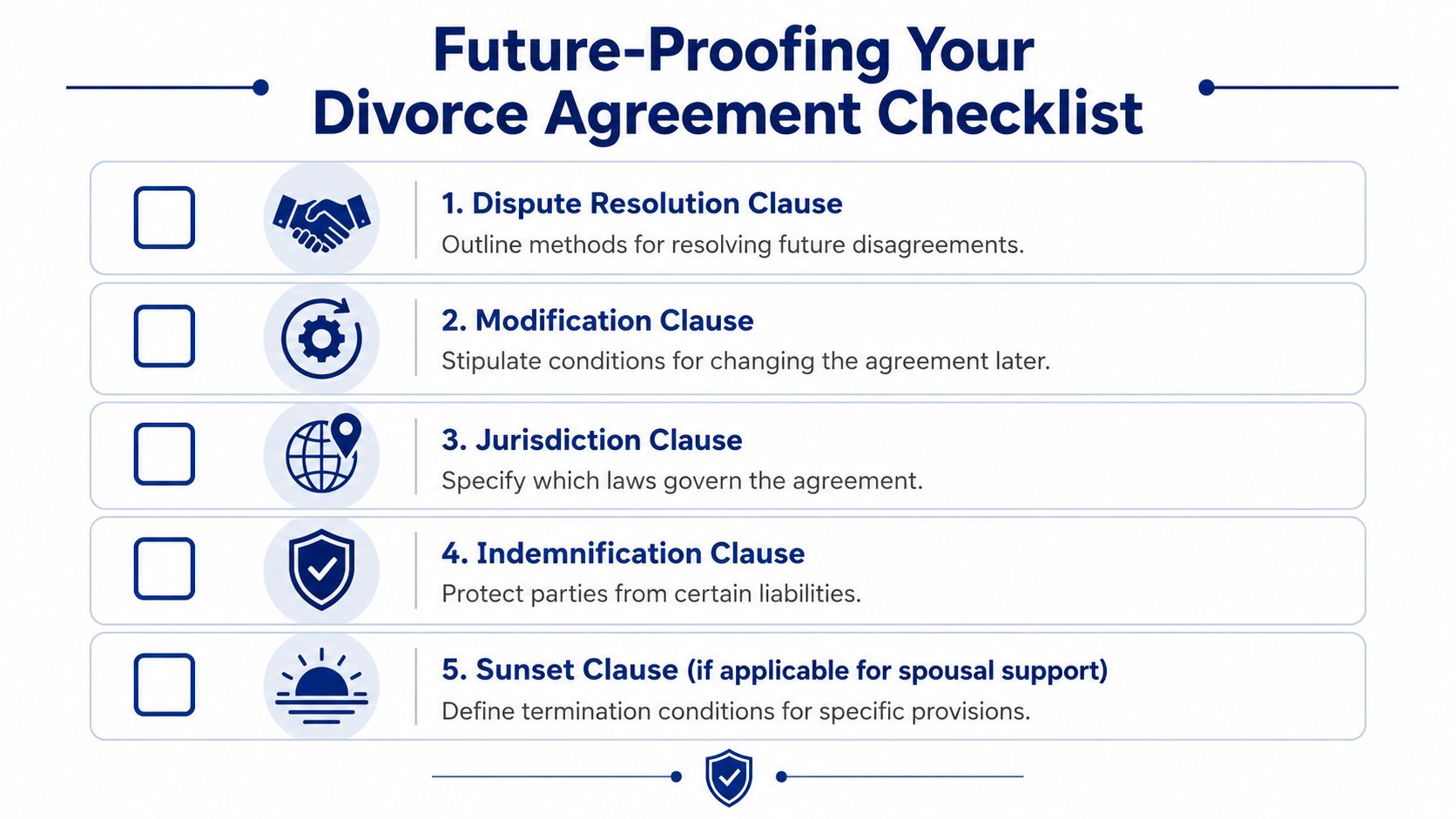
Clauses worth considering include:
- Modification procedure: State that changes must be in writing, signed by both parties, and submitted for court approval when required.
- Dispute resolution clause: Require mediation or another agreed process before certain enforcement motions, when appropriate.
- Indemnification language: If one spouse is assigned a debt, say what happens if the other spouse gets pursued by the creditor.
- Event-driven provisions: Address remarriage, sale of property, refinancing deadlines, insurance proceeds, or missed transfer dates.
- Jurisdiction language: Identify the governing court or legal framework when that issue matters in your case.
These clauses reduce friction because they answer the question people usually ask too late: what happens if the original plan no longer works exactly as expected?
Know which clauses are vulnerable
Not every clause that both spouses agree to will survive scrutiny. Some provisions are more vulnerable if they look punitive, unfair, concealed, or disconnected from legitimate divorce issues.
A clause is more likely to draw trouble if it does any of the following:
- Punishes instead of allocates: Penalty-heavy language can invite challenge.
- Depends on secret understandings: Terms withheld from the court may be harder to rely on later.
- Rests on incomplete disclosure: Hidden assets or debts can undermine the deal.
- Uses loaded but undefined words: “Reasonable,” “timely,” and “as needed” often cause disputes when they aren't anchored to specifics.
If a clause would surprise a judge, slow down and test whether it's necessary, fair, and drafted clearly enough to enforce.
Future-proofing is less about adding legal jargon and more about removing assumptions. The agreement should work even after goodwill fades.
Reviewing and Finalizing Your Divorce Contract
The last review is where many expensive mistakes are still fixable. By this stage, people are tired, eager to sign, and tempted to skim the details because the hard conversations already happened. That's exactly when omissions slip through.
Complete financial disclosure is a critical part of drafting. Guidance in this area emphasizes accounting for retirement plans, business interests, digital assets, tax liabilities, and related financial items because omissions can lead to later litigation and may undermine the agreement, as explained in this divorce agreement checklist discussion.
What to verify before signing
Read the agreement against your records, not against memory. Pull statements, deeds, loan summaries, account lists, and prior draft notes. Then check that every item appears correctly.
| Check Item | Verification Status |
|---|---|
| Names of both parties are accurate and consistent throughout | ☐ |
| Each asset is specifically identified and assigned | ☐ |
| Each debt is specifically identified and assigned | ☐ |
| Support terms include amount, timing, and ending conditions | ☐ |
| Parenting terms are detailed enough for ordinary scheduling | ☐ |
| Refinance, sale, transfer, or turnover deadlines are stated | ☐ |
| Modification procedure is spelled out in writing | ☐ |
| Tax-related responsibilities are addressed where relevant | ☐ |
| Insurance obligations are identified clearly | ☐ |
| Signature blocks, dates, and exhibits are complete | ☐ |
If one spouse will use the decree outside the United States, document handling may become a practical issue after entry. In those situations, this guide to divorce decree translation can help you understand what certified translation work may involve.
Red flags that deserve a second look
Some problems are obvious. Others hide inside language that sounds normal until enforcement becomes necessary.
Watch for these issues:
- Missing accounts or categories: If the draft covers checking accounts but says nothing about retirement, brokerage, business holdings, or digital assets, stop and reconcile the list.
- Unclear timing: “Soon after filing” or “when possible” isn't a real deadline.
- Undefined payment method: State how support or reimbursements will be paid and documented.
- One-sided knowledge: If one spouse prepared all financial summaries, the other should verify them independently.
- No legal review: Even amicable agreements benefit from separate legal eyes.
For execution planning, this practical guide on how to electronically sign a PDF is helpful once the language is final and ready for signature routing.
A draft becomes reliable only after both spouses understand it, verify it, and knowingly accept it.
Legally Executing Your Agreement with E-Signatures
Execution is not a clerical afterthought. It's the point where a negotiated document becomes a signed record with legal consequences. If the signing process is messy, poorly tracked, or inconsistent, you invite questions later about who signed, when they signed, and whether the final version was the one everyone approved.
Why execution details matter
In family law practice, the execution process should do three jobs at once. It should make signing easy enough that parties complete it promptly. It should preserve a clear record. It should also reduce the chance that someone later claims confusion about the version signed.
That's why many professionals now prefer structured electronic signing over passing around scattered attachments or printing signature pages manually. A controlled e-signature workflow can show who received the document, who signed, and when the signing occurred. It also helps keep the final file intact instead of splintering into multiple partially signed copies.
Under U.S. law, electronic signatures generally carry legal effect when the process complies with the ESIGN Act and UETA. Those are the compliance standards that matter for this discussion. For a divorce agreement contract, that means the practical question usually isn't whether an e-signature is lesser than pen and ink. The question is whether the process used was orderly, attributable, and acceptable for the filing and court context involved in the case.
A solid execution routine usually looks like this:
- Final version locked: The parties and counsel confirm the exact PDF to be signed.
- Signer sequence set: If attorneys should review before clients sign, use signing order.
- Fields placed clearly: Signature, date, and initials appear only where needed.
- Audit trail preserved: The system records the execution history in a way that can be retained with the file.
- Completed copies distributed: Everyone receives the same signed document after completion.
If you want a broader overview of the mechanics, this guide on how to sign a contract electronically is a useful reference point.
A cleaner signing workflow
For divorce documents, clean workflow matters as much as legal validity. These agreements often require review by two spouses, sometimes two lawyers, and sometimes court filing staff after execution. A poor process leads to duplicate drafts, missing signatures, and uncertainty about which copy is final.
A better approach is to keep the signing path linear. Counsel reviews. Clients sign in the intended order. The platform timestamps the activity. The final executed copy is archived and distributed automatically.
That approach is especially useful when the parties aren't in the same location, or when one spouse is hesitant and needs time to review before signing. It lowers friction without lowering formality.
Here's a short walkthrough that helps visualize how electronic signing works in practice:
The best signing process is the one that leaves the fewest loose ends. In divorce work, loose ends are what turn settled matters into return trips.
If you need a simple way to send a finalized divorce agreement contract for signature, SignWith offers a straightforward e-signature workflow with compliance aligned to the ESIGN Act and UETA, plus audit-ready records that help keep execution organized.
