
You've got a signed contract, work has started, and then the email arrives. The client wants one more deliverable. A date needs to move. Someone notices that a detail never made it into the agreement. None of that is unusual. It happens in freelance projects, service agreements, vendor deals, and real estate transactions every day.
The problem isn't that the contract changed. The problem is choosing the wrong document to record that change. Small business owners often use addendum and amendment as if they mean the same thing. They don't. The difference matters because one document adds to the agreement, while the other changes what's already there. If you mix them up, you can create conflicting terms, messy records, and avoidable disputes.
Table of Contents
- Your Contract Is Signed But Things Have Changed Now What
- Addendum vs Amendment at a Glance
- Understanding the Core Architectural Difference
- When to Use Each Document Real World Scenarios
- How to Draft and Execute Changes for Legal Enforceability
- A Simple Workflow for Managing Contract Changes with SignWith
- Frequently Asked Questions
Your Contract Is Signed But Things Have Changed Now What
A typical version looks like this. A designer signs a website contract with a small retailer. Two weeks later, the retailer asks for an extra landing page and a basic email signup flow. At almost the same time, the launch date slips because product photos aren't ready. One request adds something new. The other changes a term that already exists.
That's where many businesses freeze. They know the deal needs to be updated, but they're not sure whether to use an addendum, an amendment, or just an email thread. Email alone is where trouble starts. It's easy to assume everyone is aligned, then discover later that each side understood the change differently.
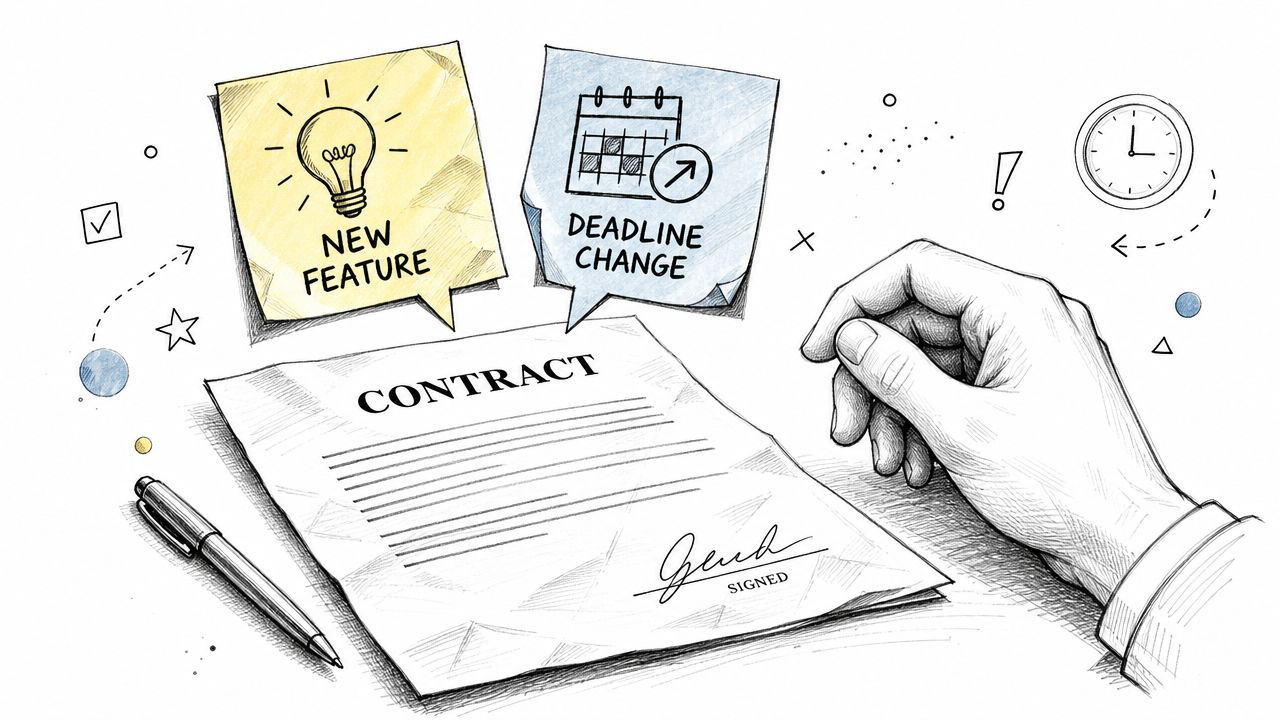
For owners who handle contracts themselves, the practical question is simple. Are you adding something that wasn't in the contract, or are you changing wording that already exists? If you answer that first, the document choice usually becomes clear.
A lot of teams also run into a process problem. They know a change is needed, but they don't have a clean way to circulate, sign, and store it. If you're still chasing approvals by email, it helps to see how businesses send documents for eSignature so the updated terms are finalized, not just discussed.
Practical rule: If the original clause stays untouched, you're usually looking at an addendum. If the original clause needs to be rewritten, you're usually looking at an amendment.
The difference between addendum and amendment isn't academic. It affects what governs the relationship when a dispute lands on someone's desk months later.
Addendum vs Amendment at a Glance
The fastest way to understand the difference between addendum and amendment is to compare what each one does to the original contract.
According to PandaDoc's explanation of addendum vs amendment, the foundational legal distinction lies in their effect on the original contract's text: an addendum adds new terms without altering existing language, while an amendment modifies, deletes, or replaces specific clauses already in the agreement. Both must be signed by all original parties to be legally binding.
That means the decision is less about labels and more about function.
| Criterion | Addendum | Amendment |
|---|---|---|
| Purpose | Adds new terms, details, or attachments | Changes existing terms already written in the contract |
| Effect on original text | Leaves the original wording in place | Modifies, deletes, or replaces existing wording |
| Best used when | Something needs to be added without conflict | A current clause is wrong, outdated, or needs revision |
| Typical timing | Often used at or near execution, or for supplemental additions | Typically used after the original agreement is fully executed |
| Risk if misused | Can create overlap if it tries to override old language | Can be too invasive when only a supplement is needed |
| Signature requirement | Must be signed by all original parties | Must be signed by all original parties |
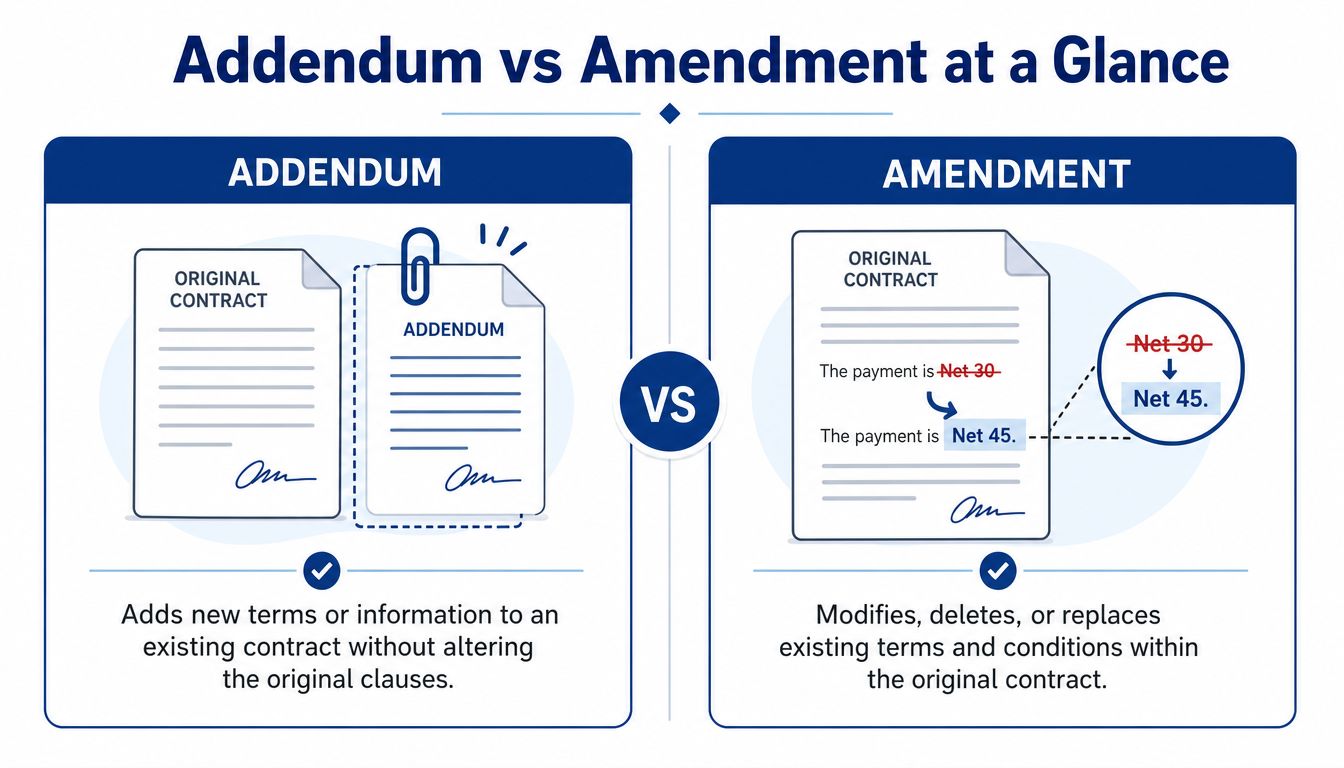
The short version
An addendum is the right tool when the parties want to attach new material that works alongside the original agreement. Think schedules, lists, clarifications, or extra obligations that weren't written before.
An amendment is the right tool when the parties need to alter an existing clause. Think payment dates, deadlines, pricing terms, or scope language that's already in the contract and now needs different wording.
The label matters less than the legal effect. A document titled “addendum” that rewrites Section 4 is functioning like an amendment, and that mismatch can create confusion.
What small business owners usually get wrong
They try to solve every contract change with one template. That's what causes sloppy records. If your contract says delivery is due on June 1, and a later document says delivery is due on June 15 without clearly amending the original clause, you've left two competing terms in the file.
That's why it helps to think in plain language. Addendum equals add. Amendment equals amend. It sounds obvious, but it prevents a surprising amount of cleanup later.
Understanding the Core Architectural Difference
The cleanest way to understand this is to stop thinking about form names and start thinking about contract architecture.
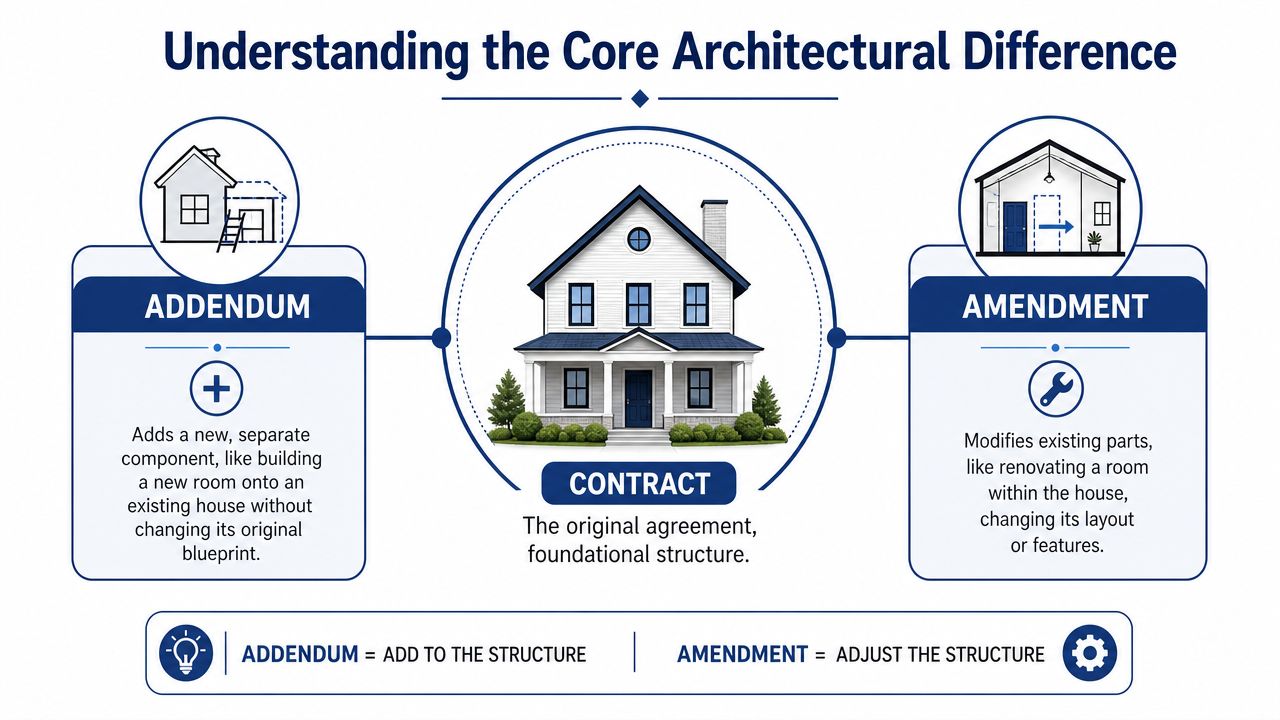
A contract isn't just a document. It's a structure. Each section does a job. Payment terms control money. Scope language defines work. Term and termination clauses govern duration and exit rights. When you change one part, you need to know whether you're attaching a new component or rebuilding an existing one.
Addendum as a supplement
An addendum acts like a supplemental attachment. It introduces new provisions without disturbing the original wording. HyperStart describes it this way in its discussion of contract architecture for addendum vs amendment: an addendum functions as a supplemental attachment that introduces new provisions without altering original clauses, whereas an amendment performs a clause-level rewrite that voids and replaces specific existing terms. An amendment directly modifies or deletes the original text, causing the revised clause to govern exclusively while the original language in that section becomes legally void.
That's the key architectural distinction.
If your service agreement never included a travel reimbursement schedule and both parties now want one, an addendum can attach that schedule. The original service agreement remains intact. The new schedule joins it and both operate together.
Here's a short explainer that visualizes the same idea from a legal drafting perspective.
Amendment as a rewrite
An amendment is different because it changes the existing contract text itself. If Section 5 says invoices are due in 15 days, and both sides agree to switch to 30 days, the amendment should identify Section 5 and replace that language directly.
That replacement effect matters. Once amended, the revised clause governs. The old clause doesn't sit there as an equal option waiting for someone to pick the version they prefer.
Use an amendment when you need one answer, not two competing sentences.
Why misuse creates risk
The most common drafting mistake is using an addendum to override an existing clause. That creates ambiguity because the original clause still exists in the contract file, and the added language may point in a different direction.
For example:
- Bad fit for an addendum: “Addendum states completion date is September 15,” while the original contract still says August 31.
- Better fit for an amendment: “Section 2.4 is deleted and replaced with the following completion date of September 15.”
The first approach leaves room for argument. The second approach tells everyone, including a future reviewer, exactly which text controls.
If you remember only one thing, remember this. An addendum expands the contract. An amendment changes it. That architectural difference is what keeps your records clean and your obligations readable.
When to Use Each Document Real World Scenarios
Theory helps, but contract work gets easier when you can spot the pattern in everyday situations.
Good uses for an addendum
Use an addendum when the original agreement can stay exactly as written and you just need to add material around it.
Common examples include:
- Attaching a deliverables list: A freelance developer signs a short master agreement, then later adds a separate list of optional integrations that weren't described in the base contract.
- Adding an exhibit or schedule: A consulting agreement may need a detailed implementation calendar that wasn't drafted into the main body.
- Including a supplemental policy: A service provider may attach confidentiality procedures, equipment lists, or onboarding instructions as an additional document.
In each of those examples, the old language doesn't need to be replaced. The agreement just needs more substance.
Good uses for an amendment
Use an amendment when the original contract already addresses the issue, but the wording now needs to change.
Typical situations include:
- Moving a deadline: The contract already has a delivery date, but both parties want a later one.
- Changing price terms: The parties agreed on one fee structure and now want another.
- Correcting party information: A legal name, notice address, or clause reference needs to be fixed in the existing text.
- Revising scope language: The original scope section is no longer accurate and needs new wording.
Small businesses often make an expensive mistake. They add a “change note” on top of an existing clause instead of amending the clause itself. That might feel faster in the moment, but it usually makes the file harder to interpret later.
If the contract already speaks to the issue, change that clause directly. Don't write around it.
The real estate exception that trips people up
Real estate has its own workflow habits, which often results in many readers hearing conflicting advice.
A verified industry-specific point matters here. A 2025 National Association of Realtors compliance report discussed in this real estate compliance video noted that 41% of disputed real estate contracts stemmed from misusing amendments for pre-closing additions, which should have been addendums. That reflects a real estate pattern where agents often use addendums to add items before final closing, such as including appliances or extra terms that weren't part of the assembled contract.
That doesn't mean “always use an addendum to stay safe” is universal legal advice. It isn't. It means real estate often treats pre-closing additions differently from other contract settings.
A practical decision test
Ask these questions in order:
Does the original contract already contain a clause on this issue?
If yes, you're likely dealing with an amendment.Are you introducing a new attachment, schedule, or obligation that doesn't conflict with current wording?
If yes, an addendum is usually the cleaner tool.Will the new language make an old clause inaccurate if both remain in the file?
If yes, don't use an addendum.
What works in practice
For freelancers and service businesses, addendums work best for supplementary details. Amendments work best for actual deal changes.
For real estate professionals, workflow norms can differ before closing. But even there, the same underlying principle applies. Add new material with an addendum. Change existing language with an amendment. The context changes. The logic doesn't.
How to Draft and Execute Changes for Legal Enforceability
A contract change document only helps if it's drafted clearly and signed correctly. Sloppy wording creates nearly as much trouble as no wording at all.
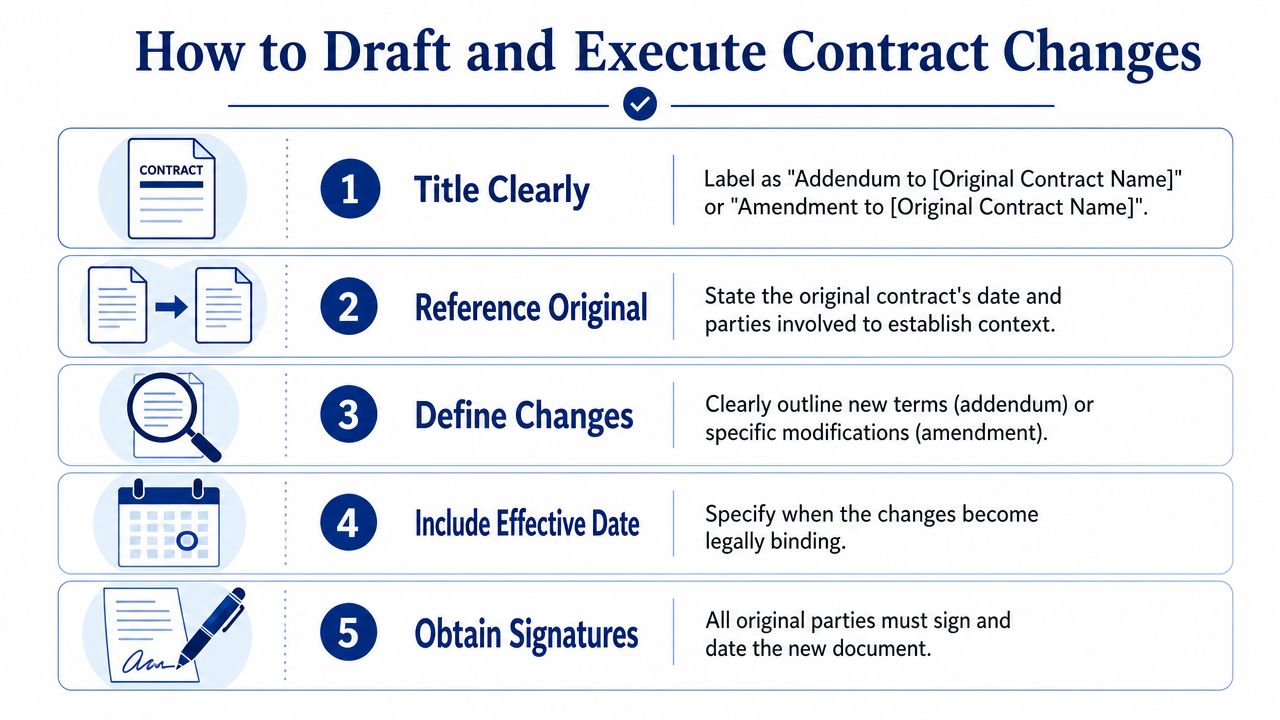
Sirion's guidance on formal execution requirements for addendums and amendments states that both addendums and amendments require the same formal execution process: identification of the original contract, precise description of changes, a title reflecting the document type, and signatures and dates from all parties. Once executed, both become part of the original contract and are legally binding.
That gives you a simple working standard.
What every change document should include
Use this checklist before you send anything for signature:
A clear title
Write “Addendum to Service Agreement” or “First Amendment to Consulting Agreement.” The reader should know what the document is before reading line two.A direct reference to the original contract
Identify the contract by name and date. Include the parties exactly as they appear in the original agreement.Precise operative language
For an amendment, specify the clause being changed. For example, “Section 3.2 is deleted and replaced with the following...”
For an addendum, state that the following terms are added to the agreement.An effective date
State when the change takes effect. That removes guesswork about timing.Signatures and dates from all original parties
If the original agreement required both parties, the updated document should too.
Drafting language that actually works
The best contract changes are boring. They don't try to sound impressive. They tell the reader exactly what changed.
A useful drafting pattern looks like this:
- For an addendum: “The following Exhibit B is added to and incorporated into the Agreement.”
- For an amendment: “Section 4.1 of the Agreement is hereby amended and restated as follows.”
That structure avoids vagueness. It also makes later review faster for your accountant, your operations lead, or your attorney.
Clear drafting reduces disputes because nobody has to guess whether the old clause still applies.
Electronic signatures and compliance
For execution, electronic signatures are a normal business tool, but legal enforceability depends on the governing rules. The E-SIGN Act was enacted on June 30, 2000, with substantive provisions effective on October 1, 2000, and it establishes that electronic records and signatures can't be denied legal effect solely because they are in electronic form, as noted by the Consumer Compliance Outlook summary of the E-SIGN Act.
Consumer-facing workflows also require attention to consent. Adobe's explanation of E-SIGN consumer consent requirements notes that consumers must give explicit, affirmative consent to conduct electronic transactions, and businesses must provide clear notice about paper copies and withdrawal of consent.
At the state level, the DocuSign overview of UETA explains that UETA has been adopted by 47 U.S. states, the District of Columbia, and U.S. territories, and gives electronic signatures and records the same legal validity as wet-ink signatures when key conditions are met.
SignWith is complied with USA standard for e-signature, ESIGN Act & UETA. If you want a clearer breakdown of terminology before choosing a workflow, this guide on digital signature vs electronic signature is useful background. For related evidence issues, especially when side conversations happen by text, this Guide to text message admissibility helps explain how written communications can matter later.
A Simple Workflow for Managing Contract Changes with SignWith
Once the document type is correct, the next problem is operational. Someone has to draft it, route it, collect signatures, and store the final copy with the original agreement. That's where small teams often lose the thread.
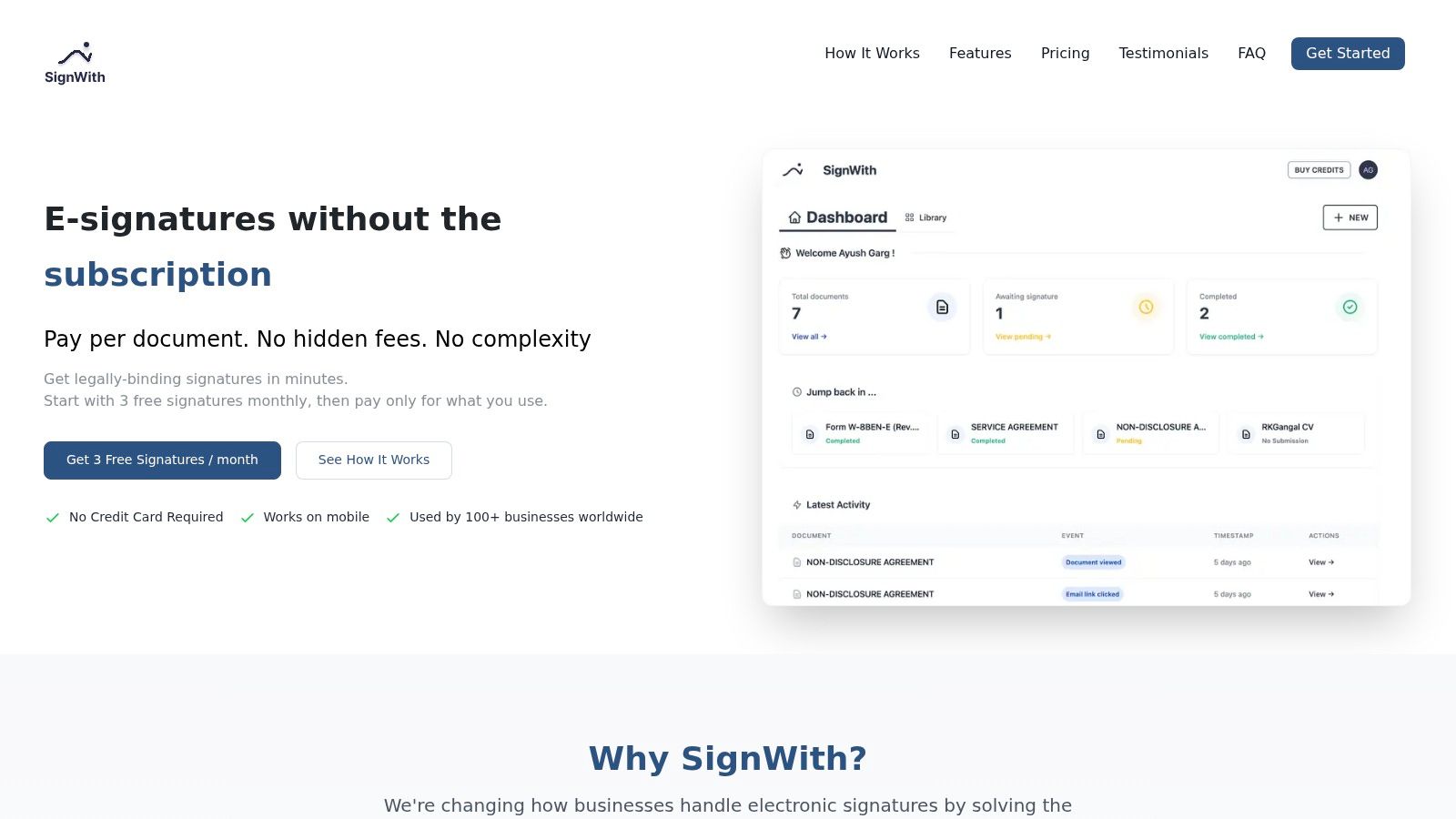
A clean five-step process
Start with the document itself. Draft the addendum or amendment in Word, Google Docs, or your preferred editor, then save the final version as a PDF. Use a file name people can recognize later, such as “Amendment 1 Client Services Agreement” or “Addendum Appliance List Purchase Contract.”
Then move through the signature workflow in order:
- Upload the file: Put the PDF into your signing platform and keep the title plain and searchable.
- Place fields carefully: Add signature and date fields for each party. If one signer should go first, set the routing order that way.
- Send to the right people: Use the same parties who signed the original contract unless counsel advises otherwise.
- Track completion: Follow the document until every signature is in.
- Store the executed copy with the base agreement: The change document should never live in a separate mystery folder.
What works better than email chains
Email approvals are hard to audit. People reply from different threads, attachments get renamed, and final versions disappear into inboxes. A structured e-sign workflow keeps the change document in one place and preserves the executed copy.
That recordkeeping discipline matters just as much as the wording. If your contracts are starting to pile up, this guide to better legal contract management is a worthwhile read because it focuses on the practical side of storing, organizing, and tracking agreement history.
Why small businesses like a simple tool
For occasional contract changes, most owners don't need a heavy enterprise system. They need something that lets them upload a PDF, place fields, send it, and get back a completed copy without turning document signing into a separate project.
If you need a lightweight way to handle one-off updates, the free eSignature tool is the kind of setup that fits small teams, independent consultants, and businesses that don't want subscription overhead for occasional documents.
The best workflow is the one your team will use every time. Consistency beats sophistication here.
Frequently Asked Questions
Can I use an addendum after the contract is signed
Yes, if the purpose is to add new terms rather than change existing language. Timing alone doesn't decide the document type. Function does.
Can one party amend a contract without the other
No. A unilateral change has no legal effect if the agreement requires mutual consent. For contract changes to be binding, all original parties need to agree and sign.
What if the change is very small
Small changes still need the right document. A typo in an existing clause can still call for an amendment because you're correcting contract text that already exists.
Should I rewrite the whole contract instead
Sometimes that's cleaner, especially when changes are broad and touch many sections. But if the agreement is still sound, a focused addendum or amendment is often easier to manage and easier to read later.
Do I need to attach the change document to the original contract
Yes. Keep them together in the same file or contract record. That creates a clean history and helps anyone reviewing the agreement understand which terms govern.
What's the simplest way to choose between the two
Use this rule:
- Choose an addendum if you're adding something new.
- Choose an amendment if you're changing something already written.
That simple test prevents most mistakes.
If you need to send an addendum or amendment without paying for another subscription, SignWith is a practical option. It supports legally binding e-signatures under ESIGN Act & UETA, keeps the process straightforward for small businesses, and makes it easier to get revised contract documents signed, completed, and stored without extra friction.
