
You're probably in one of two situations right now. Either a client wants to “just get started” and sort out paperwork later, or a developer has already begun work based on a Slack thread, a proposal PDF, and a few assumptions nobody wrote down clearly.
That's how software projects drift into the same avoidable mess. The client thinks a mobile app includes an admin dashboard. The freelancer thinks post-launch fixes are billable. An agency assumes payment is tied to calendar dates. The startup founder assumes payment is tied to investor funding. Then the first disagreement lands, and everyone starts searching old emails for proof of what was agreed.
A software development contract is what stops that spiral. It sets the boundaries before pressure, deadlines, and money distort the relationship. For freelancers and small businesses, that matters even more because you usually don't have an in-house legal team, a procurement department, or cash reserves that can absorb a bad project.
Table of Contents
- Why Your Next Project Needs a Contract Yesterday
- Deconstructing the Software Development Contract
- Choosing the Right Contract Model for Your Project
- The Anatomy of a Bulletproof Contract Essential Clauses
- From Draft to Deal A Practical Negotiation Guide
- Making It Official Compliance and Secure E-Signatures
- Frequently Asked Questions
- Do I need a lawyer for every software development contract
- What should I do first if the other party breaches the contract
- How should international clients handle governing law
- How do I handle pre-existing libraries or tools I used before the project
- Can I start work before the contract is signed if the client is in a hurry
Why Your Next Project Needs a Contract Yesterday
The fastest way to ruin a promising build is to start with a vague agreement.
A founder hires a freelance developer to build an MVP. The developer quotes for core functionality. Two weeks in, the founder asks for role-based permissions, reporting, and a Stripe workflow because those features are “part of the product.” The developer delivers working code but doesn't hand over deployment scripts because ownership was never discussed. The founder delays payment because testing is “still ongoing.” Nobody is acting irrationally. They're just operating from different versions of the deal.
That gap gets more expensive in a growing market. The global software development market is projected to grow from USD 0.64 trillion in 2026 to USD 1.11 trillion by 2031, and that expansion, combined with a shortage of senior developers, increases the need for formal contracts that manage risk and secure talent for important projects, according to Mordor Intelligence's software development market outlook.
For freelancers, a contract provides a strong position before the work starts. It lets you define what's included, what triggers extra fees, when invoices are due, and what happens if the client stalls. Without that defined position, the client's urgency becomes your unpaid project management burden.
For small businesses hiring developers, the contract does the opposite. It protects you from paying for vague promises, soft timelines, undocumented dependencies, and code you can't legally use the way you expected.
Practical rule: If a project is important enough to build, it's important enough to define in writing before the first commit, mockup, or invoice.
The point isn't mistrust. The point is to keep a good relationship from getting damaged by fuzzy assumptions. Good contracts don't create friction. They remove it.
Deconstructing the Software Development Contract
A software development contract works best when you treat it like a blueprint, not a threat.
If you were building a house, you wouldn't rely on a few texts saying “three bedrooms, modern kitchen, nice finish.” You'd want plans, dimensions, materials, sequence, approvals, and cost triggers for changes. Software is no different. The only reason people pretend it is, is because code feels flexible. Flexibility without definition is where projects break.
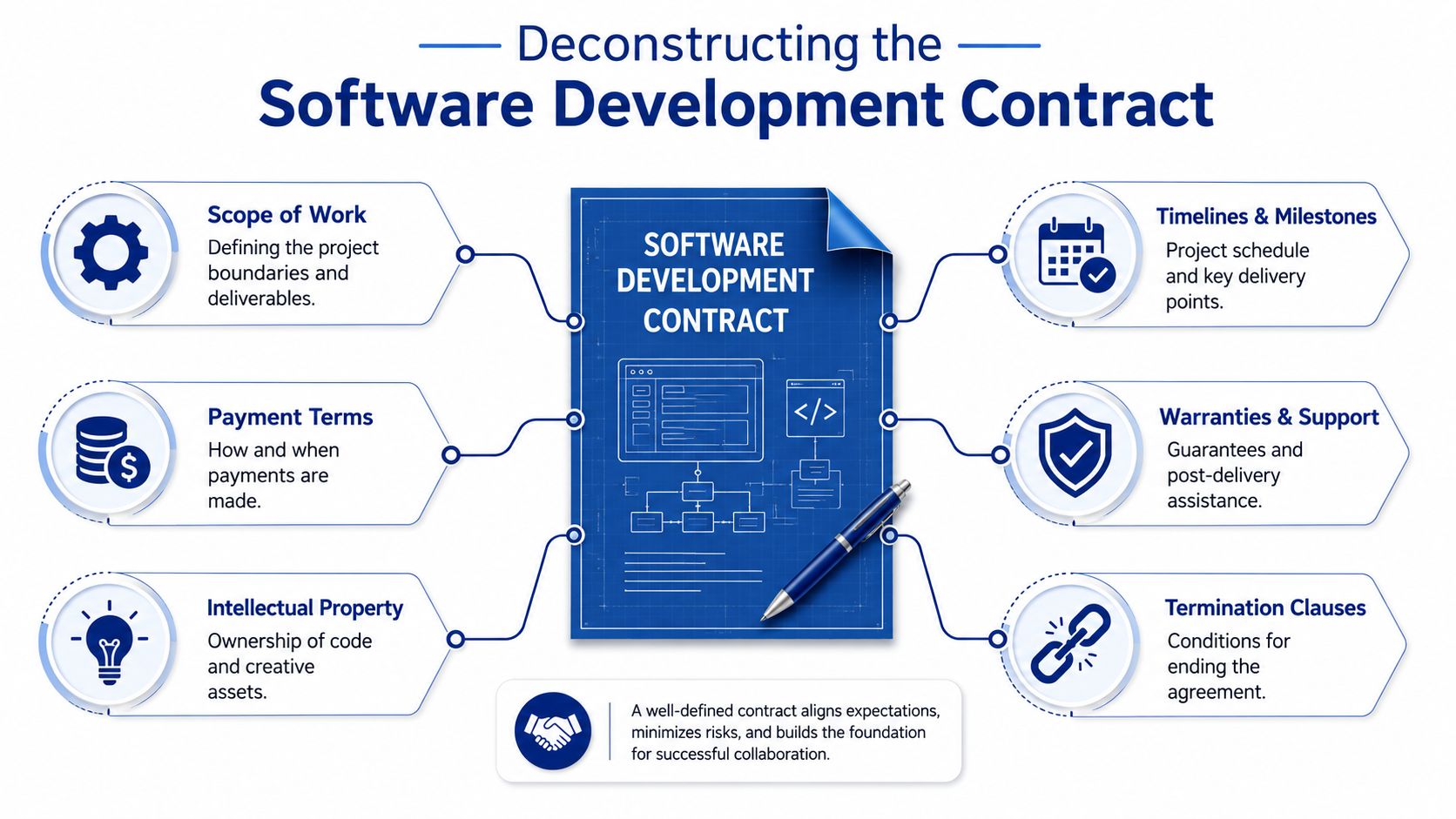
A contract is a project blueprint
A strong software development contract gives everyone one shared reference point. When the client says, “I thought analytics were included,” and the developer says, “That wasn't in scope,” the contract should settle that in minutes.
That blueprint function matters more than the legal language itself. Most disputes don't begin in court. They begin in kickoff calls, sprint reviews, and invoice threads. A good contract keeps those conversations grounded in agreed terms instead of memory.
Think of it as a working document that answers six core questions:
- What is being built: features, platforms, integrations, exclusions.
- Who is responsible for what: code, content, approvals, hosting access, testing.
- How payment works: model, invoice timing, late-payment consequences, expense treatment.
- When work is considered delivered: milestone definitions, review windows, acceptance standards.
- Who owns the output: custom code, pre-existing code, third-party tools, licenses.
- How the relationship ends: termination rights, handoff duties, final payment obligations.
What belongs in the blueprint
The mistake I see most often is overvaluing the intro pages and undervaluing the operating clauses. The contract's practical value lives in the middle, where the work gets defined.
The best software development contract is boring to read and easy to run. If the people doing the work can't use it during the project, it's too abstract.
At minimum, your contract should clearly address:
| Component | Why it matters |
|---|---|
| Scope of work | Stops assumption creep and feature inflation |
| Payment terms | Protects cash flow and avoids “pay when convenient” behavior |
| IP ownership | Prevents fights over source code, reuse rights, and dependencies |
| Timelines and milestones | Creates accountability on both sides |
| Warranties and support | Separates delivery from ongoing maintenance |
| Termination clauses | Gives both parties a safe exit path |
When readers call contracts “legal paperwork,” they usually mean they've seen bad ones. A useful software development contract is operational. It tells the project manager what to chase, tells the freelancer what to bill, and tells the client what approval means in practice.
Choosing the Right Contract Model for Your Project
The contract model changes the power balance before anyone writes a line of code.
That's why this choice deserves more attention than it usually gets. In the United States, employment of software developers is projected to grow 15% from 2024 to 2034, creating about 129,200 annual openings, and the median annual wage was $133,080 in May 2024, according to the U.S. Bureau of Labor Statistics profile for software developers. Talent is expensive. Demand is high. If you choose the wrong pricing model, the contract will magnify that mistake for the entire project.
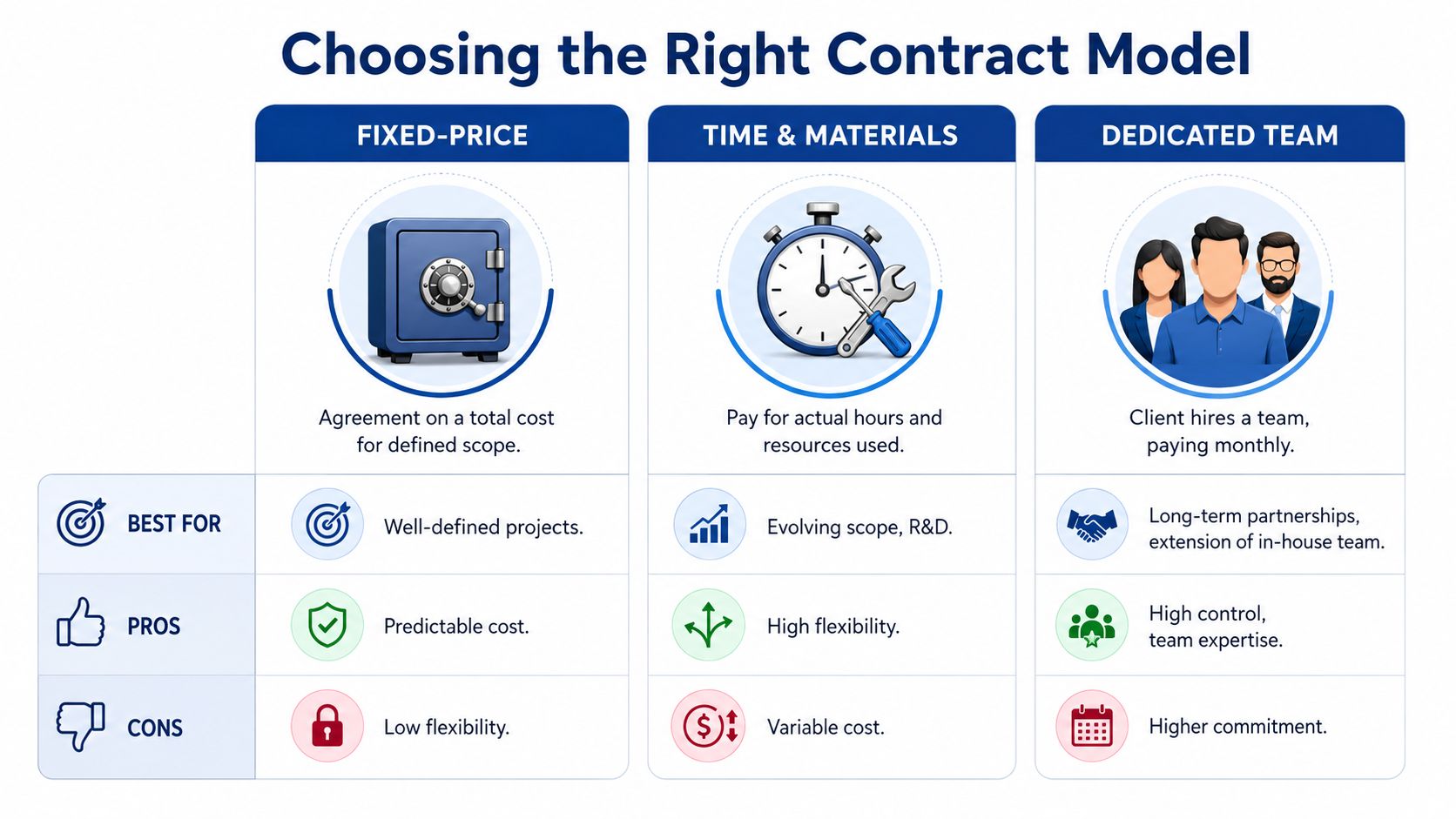
How the models shift leverage
Fixed-price works when scope is narrow, stable, and documented in enough detail that both sides can estimate effort with confidence. Clients like it because cost feels predictable. Developers often underprice it because they're really being asked to sell certainty, not just labor.
If you're a freelancer, fixed-price can be profitable when you control requirements tightly and write exclusions with discipline. If you're an SMB client, it can work well for a contained build like a landing-page site, a simple internal tool, or a clearly defined integration.
Time and materials is the honest model for work that will evolve. Product discovery, agile builds, API work with unknown constraints, and MVPs often fit here. The client takes more budget risk, but gets more flexibility. The developer gets paid for actual effort, but must document time and decisions clearly.
This model works best when the client is responsive and capable of making decisions quickly. It fails when the client wants fixed-price certainty while behaving like the scope is still open.
Milestone-based sits between the two. It's useful when both sides want staged commitment. A discovery phase can be one milestone. Design approval can be another. Beta delivery and production launch can follow. This model gives freelancers payment checkpoints and gives clients natural review gates.
The weakness is that bad milestone drafting hides the same old problem. If a milestone says “deliver dashboard,” that's vague. If it says “deliver authenticated dashboard with listed modules from attached specification,” that's manageable.
Software Contract Models Compared
| Model | Best For | Client Risk | Developer Risk |
|---|---|---|---|
| Fixed-Price | Well-defined projects with stable requirements | Paying for a spec that may become outdated | Scope creep and underestimation |
| Time & Materials | Agile projects, R&D, evolving MVPs | Budget expansion if decisions drift | Client pushback on hours or pace |
| Milestone-Based | Phased builds with natural review points | Ambiguous approvals delaying progress | Payment delays tied to vague milestone language |
A simple rule helps here:
- Choose fixed-price when requirements are settled.
- Choose time and materials when learning is part of the project.
- Choose milestone-based when trust is good but both sides need structured checkpoints.
If someone pushes you into a model that doesn't match the project reality, that's an early warning sign. Contract structure should follow delivery reality, not wishful thinking.
The Anatomy of a Bulletproof Contract Essential Clauses
Most software disputes don't come from one dramatic betrayal. They come from ordinary ambiguity that compounds.
A bulletproof software development contract doesn't try to predict every possible problem. It does something more useful. It names the pressure points that regularly turn into fights, then gives the parties a workable rule for each one.
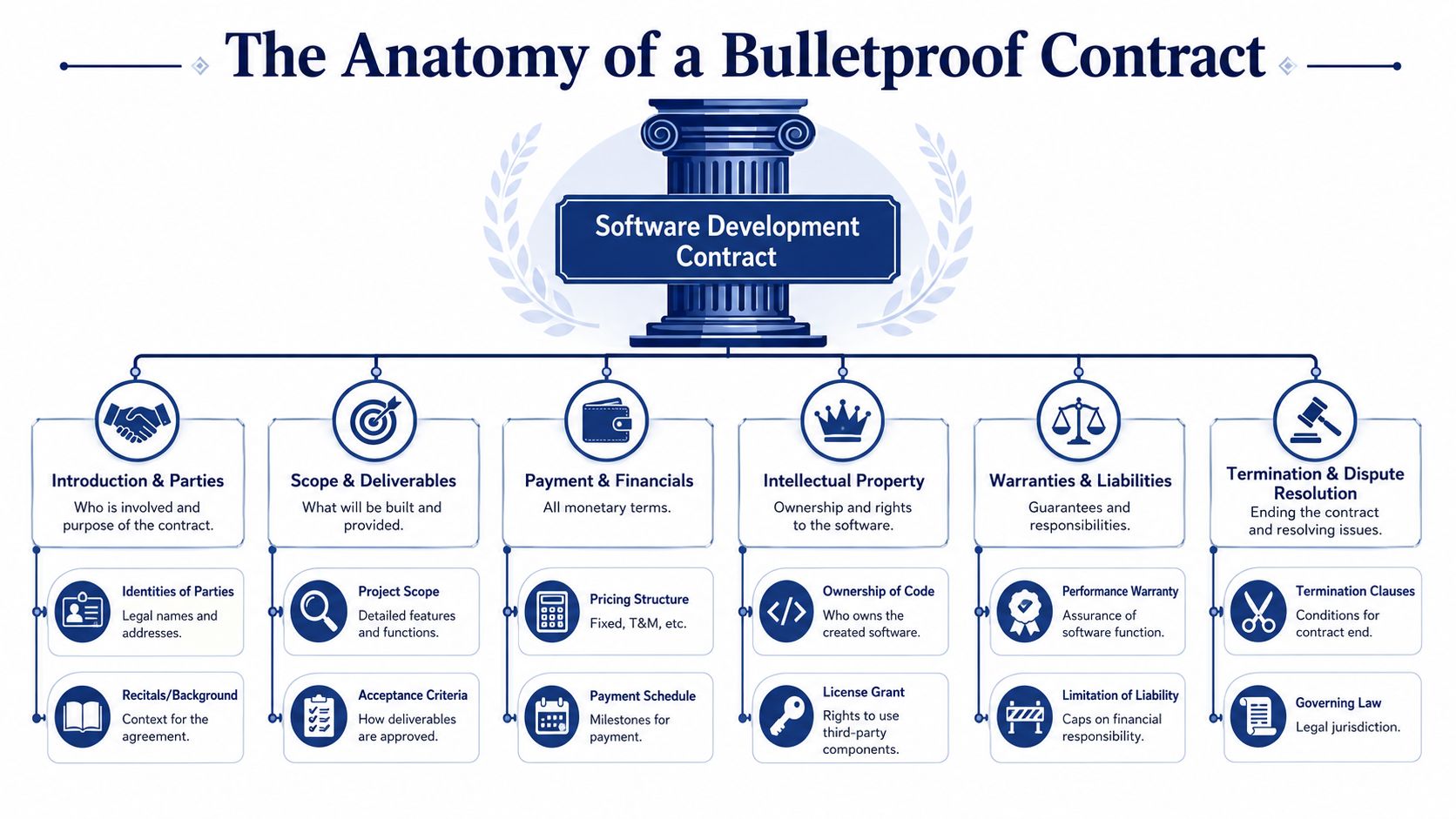
Scope is where most fights begin
The scope clause should describe what's included, what isn't, and what assumptions the price depends on. If you only attach a proposal with broad outcomes, you're inviting an argument later.
Write scope in layers. Start with the project objective. Then list deliverables. Then list exclusions. Then state client dependencies, such as brand assets, API credentials, subject-matter review, or infrastructure access.
A strong clause sounds like this:
Developer will build the web application features listed in Schedule A for browser-based use. Services do not include copywriting, data migration, third-party subscription costs, accessibility certification, security audit, or post-launch maintenance unless expressly listed in Schedule A.
That last sentence matters. Exclusions prevent “I assumed that was included” from becoming a billing dispute.
Change control belongs next to scope, not buried at the end. A robust contract should define a formal change order process, and unmanaged scope creep can increase project cost by over 30%, while approved changes commonly carry a 10 to 20% premium on hourly rates to cover re-architecting and testing overhead, as explained in Stratagem Systems' discussion of essential software contract terms.
Any request that changes features, integrations, user roles, timeline assumptions, or technical architecture must be submitted in writing as a Change Order. Developer will provide the estimated impact on cost and delivery date before work begins.
That clause protects both sides. Clients get advance visibility. Developers stop absorbing unpaid redesign work.
For readers working across borders, some of the same commercial instincts appear in essential contract tips for UK contractors from Umbrella Company. The jurisdiction differs, but the practical lesson is the same. Clear deliverables and payment triggers usually matter more than clever legal phrasing.
Acceptance criteria decide when work is done
“Done” is one of the most dangerous words in a software development contract.
A lot of templates say deliverables are accepted when provided, or after a general review period, but agile work rarely moves that cleanly. The better approach is to define acceptance by reference to observable criteria. What should work, in what environment, with what known limitations?
68% of software project disputes stem from vague acceptance definitions in contracts, especially in agile development, according to Mullen, Holland & Cooper's material on agile development agreements.
Use language like this:
A deliverable is accepted when it materially conforms to the acceptance criteria in Schedule B. Client will review within the stated review period and either accept the deliverable or provide a written list of specific nonconformities. Requests outside the acceptance criteria will be treated as scope changes.
That wording separates three buckets that often get blurred together:
- A bug: something that fails the agreed criteria.
- Included work: something already covered by the scope.
- A new request: something outside the original agreement.
If you want a related deep dive on document workflows around confidentiality before code sharing starts, this guide to e-signing an NDA properly is a useful companion read.
IP clauses need precision
Intellectual property clauses are where smaller parties often give away more than they realize.
Clients usually expect to own the custom software they paid for. That's reasonable. Developers also need to preserve rights in pre-existing tools, libraries, snippets, frameworks, and know-how they bring into the project. If the contract says the client owns “all code used in connection with the project” without qualification, the developer may accidentally assign reusable building blocks they never intended to sell.
A better structure splits IP into categories:
| IP Category | Typical Handling |
|---|---|
| Custom deliverables created for the project | Assigned to client upon full payment |
| Developer pre-existing materials | Remain developer property |
| Third-party components | Governed by their own licenses |
| Embedded reusable internal tools or libraries | Licensed to client on a non-exclusive basis where needed for use of deliverables |
Sample language helps:
Upon receipt of all amounts due, Developer assigns to Client all right, title, and interest in the custom deliverables expressly created for Client under this Agreement, excluding Developer Materials and third-party materials.
Developer retains ownership of all pre-existing code, routines, libraries, templates, tools, and know-how used in performing the services. To the extent such materials are incorporated into the deliverables, Developer grants Client a non-exclusive license to use them as part of the deliverables.
That split is practical, not evasive. It gives the client the benefit of the product while preserving the developer's ability to reuse their own toolkit.
Payment, liability, and exit terms protect cash flow
Payment terms should answer four things clearly. How much, when invoiced, when due, and what happens if approval or access is delayed.
Freelancers should resist contracts that tie payment to vague business outcomes. “Payable after successful launch” sounds simple until launch depends on the client's content delays, legal review, or infrastructure choices. Tie payments to delivery events you can control or document.
Try language like this:
Invoices are due upon issuance according to the milestone schedule in Schedule C. Client delay in providing required materials, approvals, or access extends delivery dates accordingly and does not delay payment for completed work.
Confidentiality and data handling should also be explicit, especially if code access starts before the master agreement is fully operational.
Liability clauses deserve calm attention. If you're a solo developer, unlimited liability can be ruinous. If you're the client, a clause that disclaims everything may leave you exposed. Aim for a balanced structure that allocates responsibility without pretending software can be risk-free.
Termination language is often overlooked until the relationship sours. Don't wait for that. Your contract should say who can terminate, on what notice, what cure period applies for breach, what gets handed over, and what must still be paid.
Either party may terminate for material breach if the breach is not cured within the stated cure period after written notice. Client will pay for services performed and approved expenses incurred through the effective termination date. Upon payment of all outstanding amounts, Developer will deliver completed work product in its current state.
That's how you keep a difficult ending from becoming a destructive one.
From Draft to Deal A Practical Negotiation Guide
A good contract rarely appears in one perfect draft. It gets built through review, redlines, and a few uncomfortable conversations that are better handled early.
Freelancers often feel they have less room to negotiate than larger vendors. Small businesses hiring developers often feel they have to accept whatever paper is put in front of them. Both instincts are costly. Most contract terms are negotiable if you can explain why the revision helps the project run better.
Start with the process map below.
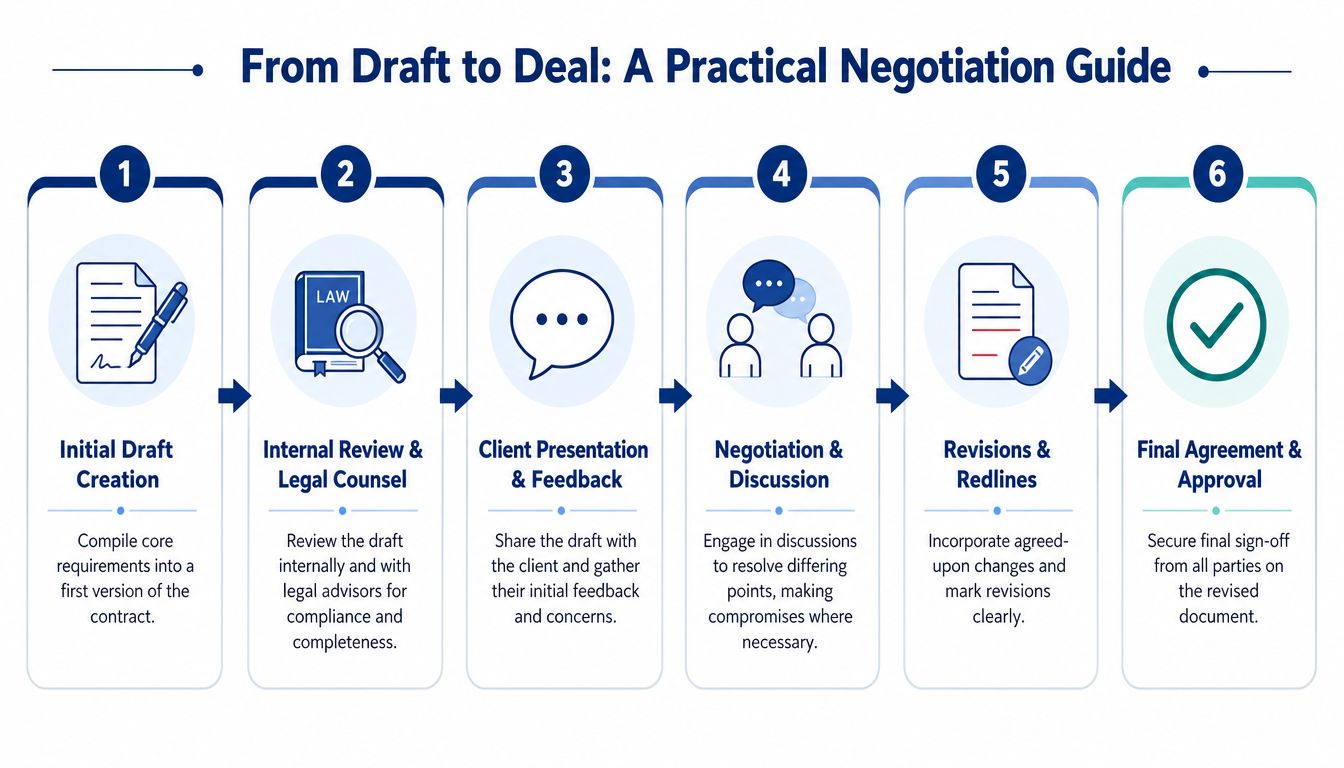
A workable negotiation flow
Use a contract template as a starting point, not a substitute for thinking. Generic free templates often miss the exact issues that software projects trip over, especially staged acceptance, change orders, and partial handoffs.
A practical workflow looks like this:
- Build the first draft from the project facts. Pull in scope, milestones, pricing model, ownership assumptions, dependencies, and support limits.
- Mark the commercial pressure points. Payment timing, approval windows, revision limits, and change procedures should be visible, not implied.
- Redline with reasons. Don't just say “please revise.” Say, “This needs to distinguish bug fixes from new features so billing doesn't become subjective.”
- Negotiate by trade-off. If the client wants broader warranty language, you may want tighter acceptance criteria. If the developer wants faster payment, the client may want stronger milestone definitions.
- Freeze the exhibits. Scope schedules and acceptance schedules should match the final draft before signature.
A short explainer can help if you're setting up the signing workflow for the first time. This guide on sending documents for e-signature walks through the operational side cleanly.
The acceptance issue deserves special attention because it causes so many project fights. This short video is useful before final review:
Red flags freelancers and SMBs should catch early
Some red flags are obvious. Others are dressed up as efficiency.
Watch for these:
- Payment tied to vague satisfaction: “Client will pay when satisfied” is not a payment term. It's an invitation to subjective delay.
- Unlimited revisions: If the contract doesn't cap revision rounds or route new requests through change control, scope will drift.
- One-way IP language: If all code, tools, methods, and derivatives transfer automatically, the developer may be giving away far more than the client needs.
- No response deadlines: If the client has no deadline to review, approve, or reject work, the project can stall while invoices hang.
- Oral change culture: If one side says “we'll figure changes out on calls,” insist on written confirmation. Software disputes often start where documentation stops.
Don't negotiate from fear. Negotiate from project reality. The fairest clause is usually the one that makes responsibility easiest to prove later.
When the other side resists clarity itself, not just a specific term, take that seriously. People who plan to act reasonably later usually don't object to writing reasonable rules now.
Making It Official Compliance and Secure E-Signatures
A contract isn't finished when the redlines stop. It's finished when the right people sign it in a way that holds up.
Remote work changed how software teams engage each other, but it didn't reduce the need for valid execution. If anything, distributed teams need stronger process because there's no conference room signing moment, no paper file, and often no shared office jurisdiction.
Execution matters as much as drafting
In the United States, the legal baseline is straightforward. Under the federal ESIGN Act, a signature or contract can't be denied legal validity because it is electronic, and together with UETA it forms the legal framework for enforceable e-signatures across the country, as summarized in this overview of ESIGN and UETA legal standards.
That means electronic signature workflow is not a shortcut around legality. It's the normal path, provided the process follows the applicable rules.
What compliant signing looks like
For U.S. contract workflows, the compliance points worth naming here are ESIGN Act and UETA. Those are the standards that matter in this context. A proper platform should support consent-based electronic signing, preserve reliable records, and maintain an audit trail that shows who signed and when.
For teams that also compare operational approaches in other markets, managing contracts for UK firms offers a useful outside perspective on process and tooling, even though the governing legal framework differs.
If you need the practical steps for a signer-facing workflow, this walkthrough on how to sign a contract electronically covers the basics clearly.
The final point is simple. Don't let a carefully negotiated software development contract fall apart at the execution stage because the signing process is sloppy, incomplete, or hard to verify later. Good drafting deserves equally solid signing.
Frequently Asked Questions
Do I need a lawyer for every software development contract
Not for every contract. But you do need judgment. If the project is high-value, involves sensitive data, includes custom IP arrangements, or comes with one-sided liability language, legal review is usually money well spent. For routine work, a strong template plus careful customization often gets you most of the way there.
What should I do first if the other party breaches the contract
Start by documenting the exact clause involved, the facts, and the timeline. Then send written notice that matches the contract's notice and cure process. Don't jump straight into threats. Many disputes can still be contained if the record is clean and the requested fix is specific.
How should international clients handle governing law
Pick one governing law clause and one dispute venue clause, then make sure both parties understand the practical effect. The worst outcome is thinking you have a clear contract while the enforcement path is scattered across countries and inconsistent terms.
How do I handle pre-existing libraries or tools I used before the project
Handle them expressly. This is a common blind spot. Over half of new software contracts fail to include permissive license terms for third-party components, creating infringement risk, and a non-exclusive licensing strategy is a common solution for pre-existing developer libraries, as discussed in Atomic Object's guide to writing software development contracts.
That usually means the client owns the custom deliverable, while the developer keeps ownership of their older tools and grants the client the rights needed to use the final product.
Can I start work before the contract is signed if the client is in a hurry
You can, but it's usually a mistake. If urgency is real, sign a narrow interim agreement that covers scope, payment, confidentiality, and ownership for the immediate work. Starting without anything in place often creates the exact confusion the full contract was supposed to prevent.
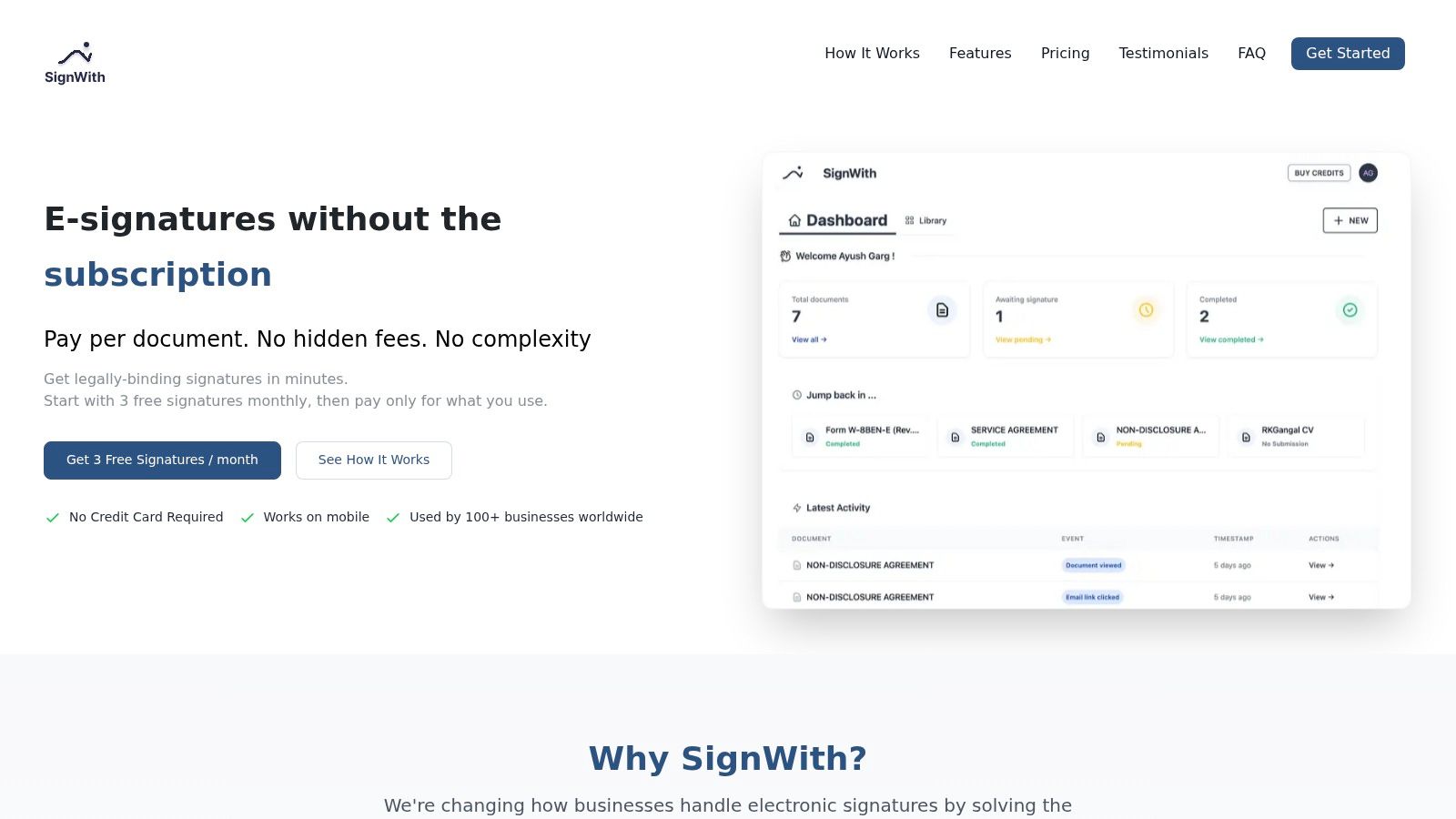
If you want a simple way to finalize contracts without subscriptions, SignWith is a practical option for freelancers, startups, and small teams. It supports U.S. e-signature compliance under ESIGN Act and UETA, lets you send documents without locking yourself into monthly fees, and keeps the signing process straightforward when you just need to get an agreement out, signed, and archived properly.
